
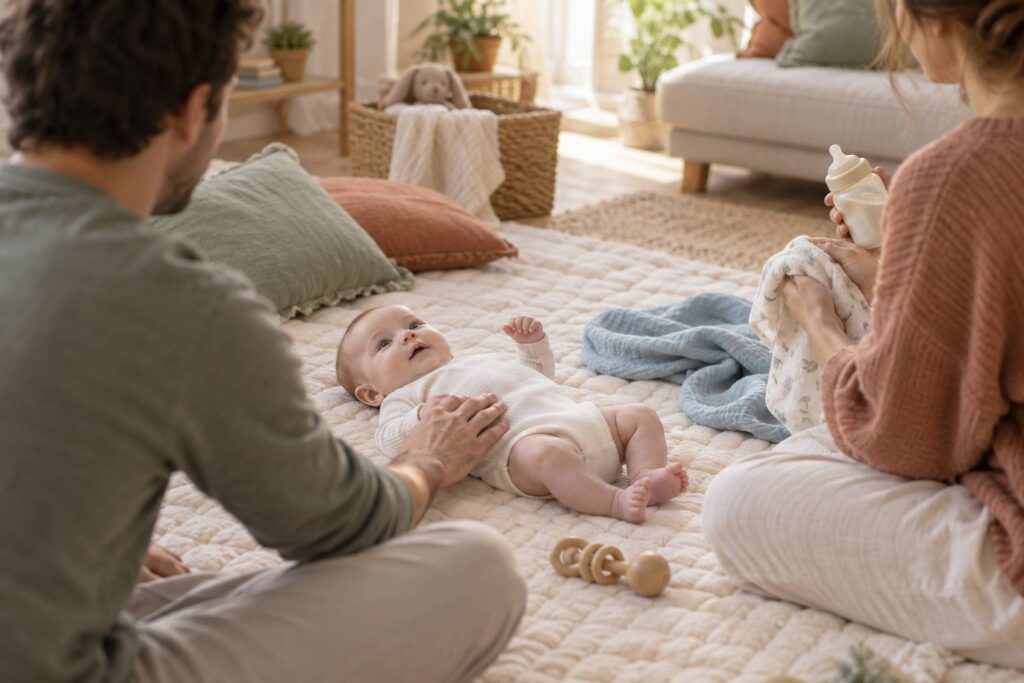
Baby month by month: motor milestones and awakening 0–3 months
In the first weeks, the focus is mainly on primitive reflexes, breathing, feeding, and the stabilized bodily relationship with the parents. The milestones are not immutable rules but useful markers to detect if additional support is needed. The thread of this article follows the fictional family of Lucas, Emma, and their baby Noé to illustrate daily how to observe and stimulate awakening.
During the first month, the baby shows sucking reflexes, grasping, and overall tone still fluctuating. The simple observation: when a finger approaches the palm, the hand closes — this indicates normal integration of the grasp reflex. For Noé, Emma noticed that the right hand closed more vigorously; during the consultation, the team explained to her that this is common and that symmetry often improves in the first weeks.
Concrete examples and useful gestures
To promote head control, simply place the newborn on their stomach several times a day, under supervision, for short periods. This progressive tummy time helps strengthen neck muscles and prepares for rolling over. A simple strategy: five minutes after the diaper change, place the baby on the stomach while speaking softly and offering a high-contrast toy at 20–30 cm.
If the baby initially refuses this position, several short and regular attempts are preferable to a long stressful session. In Noé’s case, a two-week phase with three short sessions per day was enough to observe a marked improvement in axial control and visual interest.
Reassuring signs and signs that require professional advice
Reassuring signs include orientation toward the voice, sustained looks for a few seconds, and the reaction to sudden sounds by startling. Conversely, a persistent absence of visual tracking at 6–8 weeks or a total lack of response to sounds requires an evaluation. It is recommended to consult a professional if concerns persist.
To reduce parental anxiety, some practical markers: note progress, share observations during consultations, and use reliable resources like viedeparents.eu for guidelines and concrete advice.
Anecdote and demonstration
A concrete example: during a home visit, the nurse suggested to Emma a simple game — slowly bringing a high-contrast cloth toward Noé to stimulate visual tracking. In less than a week, Noé showed longer fixation on the fabric. This progression illustrates that daily gestures, integrated into care, are often sufficient to support motor and sensory awakening.
Practical key: integrate mini-stimulation sessions into the routine (diaper changes, bath, feeding) to consolidate skills.
Stimulating sensory and cognitive awakening months 4–6: simple activities and markers
Between four and six months, the child displays growing curiosity and more elaborate hand-eye coordination. This is the period when manipulated objects become learning tools: the baby explores by bringing objects to the mouth, shaking, and observing the consequences of their actions.
The goal is to offer varied but appropriate stimulations: different textures, toys that make noise, unbroken mirrors for face exploration. For Noé, this phase was marked by the appearance of a toy-throwing gesture, first clumsy, then more controlled. This progress indicates a gain in motor coordination and planning.
Practical activities for each day
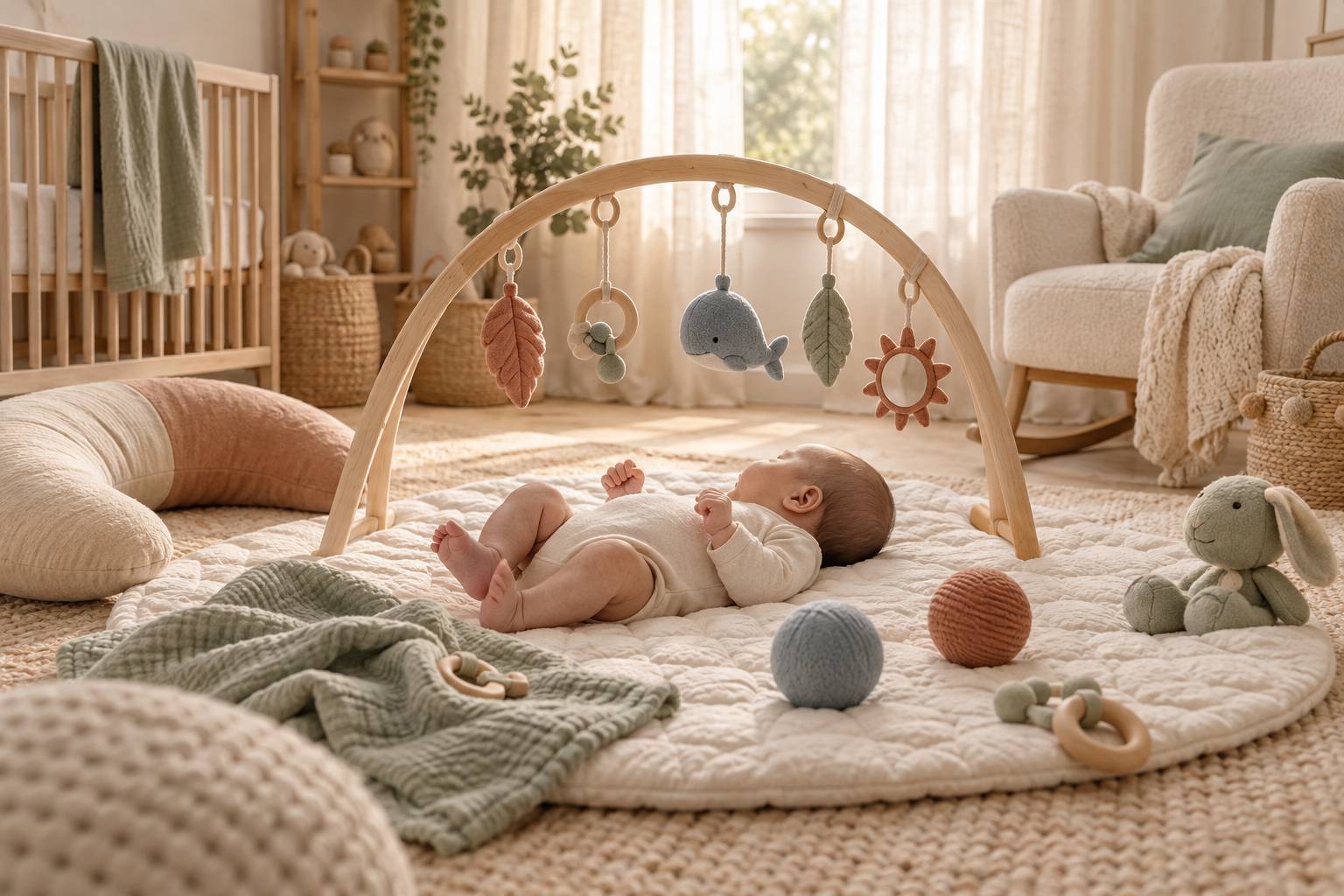
Some simple, repeated, and pleasant gestures produce great benefits. For example, offer a low mobile during time spent on the back, then encourage the baby to grasp it by moving it slowly. Varying textures (fabric, smooth wood, soft rubber) during handling times promotes tactile discrimination.
Another activity: the “cause and effect game” with a surprise box where pulling a string makes an object appear. This type of activity develops causal understanding and the ability to maintain attention.
The video above illustrates simple exercises to integrate into the day. It is important to maintain kindness: if baby appears frustrated, suggest a break before starting again.
Early language and interactions
At this age, the baby begins to produce series of vowels and consonants (babbling). Verbal interaction — talking, repeating sounds, commenting on actions — stimulates understanding and prepares the first words. When Lucas names a toy, then associates it with a gesture, Noé progressively reconnects words and objects.
Practical advice: use short and repetitive phrases, accompanied by gestures. For example: “here is the ball” while showing it, then “where is the ball?” while hiding it, to reinforce the notion of object permanence.
Observation and when to seek advice
If the baby shows no interest in handling, avoid overstimulation but check conditions: fatigue, hunger, discomfort. Professional follow-up is recommended if, at six months, there is no voluntary grasp or absence of babbling.
Anecdote: to motivate Noé to grasp, a simple adaptation was effective: a light rattle attached to the wrist during diaper changes attracted attention and encouraged the gesture. This type of practical tip, based on field experience, illustrates how small environmental changes yield great results.
Key phrase: prioritize short, varied games integrated into care to stimulate awakening without exhausting.
Social and emotional development months 7–9: attachment, games, and separation anxiety
From seven to nine months, social interaction takes a central place: the child recognizes familiar faces, shows affective preferences, and may experience separation anxiety. These reactions are normal and indicate attachment in development.
The family of Lucas and Emma observes that Noé now shows a preference for Emma’s arms, which caused temporary concern for Lucas. It is useful to explain that this preference is a sign of emotional security and not a rejection.
Social awakening games and reassuring routines
Games alternating presence and controlled absence foster trust: for example, the “peekaboo” game with varied rhythms introduces the idea that absence is temporary. The routine of rituals (bedtime ritual, specific song) reduces anxiety and anchors temporal markers.
It is important to observe how the child self-regulates: short cries followed by attention resumption indicate developing self-regulation skills. When cries become intense and prolonged, professional insight may be helpful.
The suggested video presents soothing techniques and progressive games to accompany separation anxiety without rushing.
Table of milestones months 7 to 9
| Age | Motor skills | Social/emotional skills |
|---|---|---|
| 7 months | Sits without support, finer grasp, mastered rolling | Frequent social smiles, begins “peekaboo” game |
| 8 months | Tries to get on all fours, transfers objects hand to hand | Preference for attachment figures, varied vocalizations |
| 9 months | Start of propulsion, controlled stops, emerging pointing | Recognition of routines, possible separation anxiety |
This table provides a synthetic reference while recalling that each child follows their own pace. Variations are frequent and normal.
Practical examples and real case
To help a baby suffering from anxiety, a progressive technique consists of increasing the absence time by a few seconds each day, always remaining within visual range. For Noé, Emma started by stepping away a few steps during play, then lengthened the duration while quickly returning if intense crying occurred.
Another example: establishing a transitional object (comforter or pacifier) associated with a particular song helps emotional repair when the parent is not immediately available. The important thing is consistency and the reassurance given by adults.
Key phrase: separation anxiety is a sign of healthy attachment and is worked through methodically with reassuring gestures and repetitions.
Language and communication months 10–12: first words, gestures, and symbolic play
Approaching the first year, language structures itself: gestures (pointing, waving) and first words gradually appear. The focus should be on the quality of exchanges rather than on a strict word count.
Noé, at eleven months, began associating the word “papa” with the person, then extended this connection to other words. This evolution illustrates the combination of rich verbal exposure and repetitive contexts.
Techniques to encourage first words
Talking by describing actions helps create bridges between gesture and word: “mom is pouring water,” “look at the car.” Short and musical repetitions promote memorization. Singing a song during bath time or narrating the diaper change routine adds rhythm to language.
Another method: structured turn-taking. After the baby’s vocalization, pause before repeating what was said (repetition expansion) shows the model role and provides a more structured version of the word or phrase.
List of simple activities to practice daily
- Name objects during meals and play.
- Imitate the baby’s sounds and amplify them to enrich babbling.
- Read picture books with short and repetitive words.
- Play hide and seek with objects to reinforce object permanence.
- Encourage pointing by following the finger and naming what the child shows.
Each of these activities, brief and regular, produces a strong cumulative effect on language development.
Practical case and anecdote
In Noé’s family, a simple tip accelerated word emergence: choose a weekly “target” word (e.g., “ball”) and repeat it each time the object appears. Varied contexts (games, walks, bath) reinforce the word-object association. Within two weeks, Noé started vocalizing in the presence of the ball, then producing the approximate sound.
If significant babbling absence persists after 12 months, it is recommended to consult a professional. However, most children pass these stages through consistent verbal exposure and warm interactions.
Key phrase: prioritize the quality and repetition of exchanges rather than the raw quantity of words.
Routines, sleep and feeding: practical markers for each month
Structured routines help the child orient themselves and better manage transitions. Sleep, naps, and feeding evolve rapidly during the first year: the goal is to adapt expectations and offer flexible but consistent frameworks.
Fragmented first nights are normal. To support the fictional family, it is useful to recall that setting up a consistent bedtime ritual — calm bath, dim lighting, song — gradually facilitates falling asleep. Consistency is more important than perfection.
Concrete advice for sleep
Establish end-of-day cues (reduced stimulation, calming activities) to signal bedtime. Naps should remain opportunistic: avoid strong stimuli just before. When a baby shows signs of tiredness (rubbing eyes, yawning), it is better to intervene quickly to avoid overexcitement.
For Noé, a simple fifteen-minute pre-sleep ritual proved very effective: reading a short story, cuddling, and placing in the crib. This ritual stabilized night awakenings and made nights more predictable for the parents.
Feeding and diversification
Diversification usually begins around six months but must remain gradual. Introduce one new food at a time, observe reactions, and offer varied textures to promote acceptance. Breast milk or formula remains a major nutrition source during the first year.
Some simple markers: gradually introduce vegetables then fruits, offer textured purees and later soft pieces. Family meals, sitting at the table with adults, serve as models and encourage food curiosity.
Table of typical routines by age group
| Age group | Number of naps | Main meals |
|---|---|---|
| 0–3 months | Multiple short naps (4–6) | Breastfeeding/formula on demand (8–12 times/24h) |
| 4–6 months | 3–4 naps | Breastfeeding/formula + start of diversification |
| 7–12 months | 2–3 naps | 3 structured meals + snacks, milk always present |
This summary table helps situate expectations without forgetting great individual variability.
Tips for tired parents
Some gestures help reduce daily stress: delegate a simple task to a relative, set up short but real rest periods, or prepare easy meals. The platform viedeparents.eu offers practical guides to organize days and find local resources.
Finally, it is essential to recall that a kind routine includes respecting the parent’s needs. A rested adult is more available to read baby’s signals and adapt responses.
Key phrase: establishing flexible and repetitive routines provides a reassuring framework for the child and concrete support for parents.