In brief:
- Baby bouncer: useful from the first weeks if the model is suitable, but to be used occasionally to preserve baby’s development.
- Ideal bouncer age: several models accept newborns with an insert; check the curled position and head support.
- Usage time: avoid long sessions (pediatric reference: do not exceed 1 hour and cautious recommendations around 20 minutes per session).
- Bouncer safety: comply with NF EN 12790 standard, place the bouncer on the floor, use the 5-point harness, and never leave baby unattended.
- Practical choice: favor lightness, easy maintenance, adjustable bouncer positions, and breathable materials for baby’s comfort.
Baby bouncer: promoting secure comfort from birth
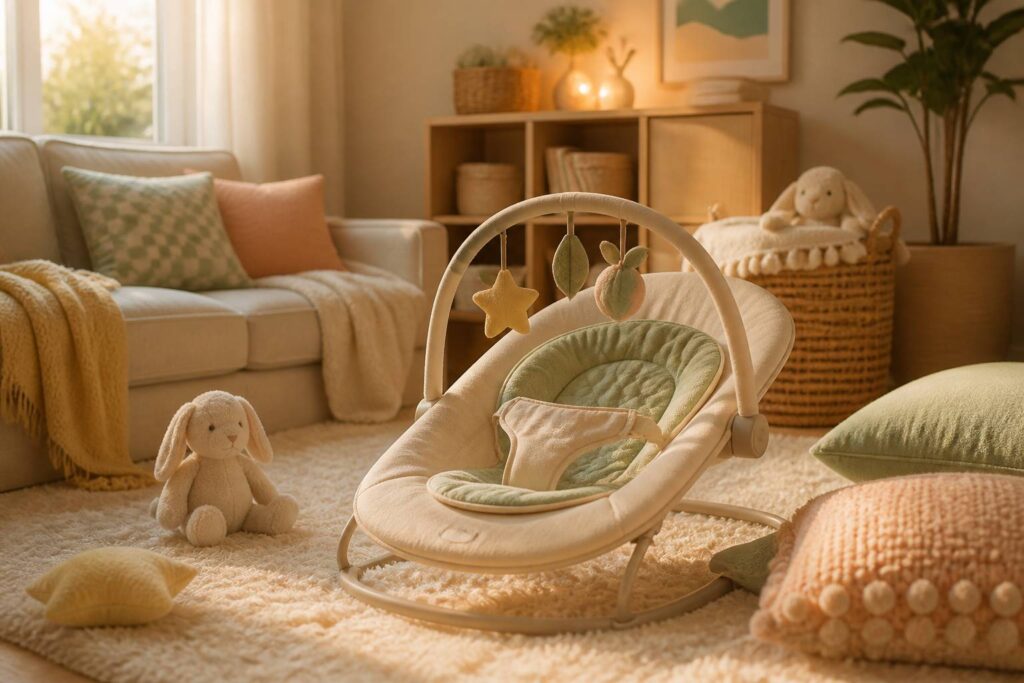
The baby bouncer meets a concrete need of exhausted parents: to safely place the infant while doing a task. Its role is not to replace arms, but to offer an adapted support point when baby needs to be set down for a few minutes. Well-thought-out use of the baby bouncer facilitates digestion, sometimes relieves mild GERD, and enables moments of awakening in a semi-upright position.
The newborn’s physiology imposes requirements: head support, natural spine curvature, and hip support. Bouncers designed for the first months often include an insert or morphological cushion to respect this fragile morphology. Choosing a suitable bouncer limits cervical tension and promotes baby’s comfort from the first weeks.
Bouncer positions and comfort: how to use them
Several bouncer positions allow adjusting the inclination depending on age and activity: a more reclined position for soothing, a more upright position for awakening and digestion. For example, after a bottle, placing baby in a slightly inclined position helps reduce gastroesophageal reflux without forcing a sitting position.
A practical example: Léa prepares dinner while Marc watches Noé in his bouncer. Noé is installed with the newborn insert and a gentle incline. When he fidgets, a slight adjustment of the position helps him sit back reassuringly and limits regurgitation. This simple gesture illustrates the useful complementarity between the equipment and parental vigilance.
Bouncer materials and thermal comfort
Bouncer materials influence well-being: breathable fabrics, hypoallergenic padding, and washable covers make daily life easier. A bouncer made of perforated synthetic materials evacuates heat better, useful in summer or in a heated house. For optimal comfort, favor a removable washable cover and textiles certified free from harmful substances.
Parent tips: test the cover texture and appreciate how easily it can be removed. Consider habits: if the equipment will travel a lot, lightness and quick drying become priorities.
Insight: a well-chosen bouncer improves baby’s comfort without replacing arms; attention to bouncer positions and materials reduces common discomforts.
Ideal bouncer age: when to start placing your infant?
The question of ideal bouncer age often arises among new parents. Manufacturers design most models to accommodate infants from the first weeks. However, it is not enough for the product to be labeled “from birth.” Actual adaptation to baby’s morphology and the possible presence of an insert must be checked. Using a baby bouncer with a newborn may be appropriate if simple rules are followed.
The practical rule: for a newborn, optimal support is in a curled position. This position respects the natural spinal curvature and avoids neck strain. A bouncer equipped with an insert recreates this cocoon. Without an insert, it is better to wait until the baby gains some weight and neck strength.
Concrete examples by age
0–2 months: Very young babies benefit from an insert and gentle inclination. Short and supervised use is recommended. In this dual context, bouncer safety must be maximal.
3–6 months: Most infants can still enjoy a bouncer, notably for moments of awakening. The important thing is observing development: as soon as the child starts to straighten up, turn, or tries to sit up, the bouncer loses its interest.
From 6–9 months: Many models indicate use up to 9 kg or up to 9 months. But the key criterion remains the child’s ability to sit alone. At this stage, guiding towards a suitable chair promotes motor skills.
Practical choice for newborn comfort
Among favored references, some evolving bouncers can adapt for a long time: BabyBjörn for its simplicity and inclinations, Béaba’s Up & Down for its insert and adjustable heights, Babymoov’s Doomoo nest for its soft cocoon, and Badabulle’s Easy Moonlight for head morphological support and rocking options. Testing the model in-store, if possible, allows feeling the support and evaluating stability.
A practical tip: keep a play mat nearby to alternate moments in the bouncer and times on the floor promoting free motor skills. This alternation limits negative effects on baby’s development while giving parents some leeway.
Guide to choosing a bouncer provides concrete markers for choosing according to age and need. Consulting such resources helps avoid unsuitable purchases.
Insight: ideal bouncer age depends on both the product and individual development; favor the curled posture and short sessions.
Baby bouncer usage duration: respect usage time for well-being
The question of usage time is central. Pediatricians advise against leaving an infant in a bouncer for too long. In practice, it is recommended not to exceed one hour accumulated per day on the same equipment, and some expert voices recommend shorter sessions, for example, 20 minutes at a time, to preserve skull shape and natural motor skills.
Why these limits? Prolonged support in a semi-reclined position restricts limb movement, limits free motor skills, and can promote plagiocephaly in very immature babies. Alternating with a play mat or hand-to-hand carrying compensates for these effects and stimulates motor development.
Planning sessions: a concrete approach
Simple calendar for a typical day: morning — 15–20 minutes after breakfast to allow the parent to prepare a meal; mid-morning — floor play session; afternoon — 15–20 minutes during a short nap or for a change; late afternoon — moment of awakening and interaction. This organization limits prolonged sessions and maintains freedom of movement.
Family example: Léa and Marc have established a gentle rule at home: no more than 20 consecutive minutes, then 30 minutes of activity on the floor. This ritual reduced evening crying because baby could move and expend energy during the day.
List of practical rules
- Limit each session to 20–60 minutes depending on baby’s age and behavior.
- Alternate bouncer and play mat several times a day.
- Monitor posture and comfort; adjust the harness if necessary.
- Avoid prolonged use in a vehicle or on a couch.
- Favor calm moments rather than using the bouncer as the main babysitter.
Incorporating these good practices into the family routine allows using the equipment wisely, without guilt, and with baby’s development in mind.
Insight: the bouncer provides valuable help if usage time is controlled; respecting short and varied sessions protects motor development.
| Approximate age | Indicative weight | Recommended usage time | Remark |
|---|---|---|---|
| 0–2 months | 0–5 kg | 10–20 min per session, max 1 h/day | Use insert, monitor head |
| 3–6 months | 5–8 kg | 15–30 min per session, max 1 h/day | Alternate with play mat |
| 6–9 months | 8–9 kg | Short sessions depending on activity | Transition to chair or floor when baby sits |
Bouncer safety: rules to follow for safe use
Bouncer safety is based on simple but non-negotiable actions. Always verify that the model complies with the European standard NF EN 12790. This certification attests tests on stability, harness retention, and absence of dangerous mechanical risks. Careful checking of marking and manufacturer instructions protects the baby.
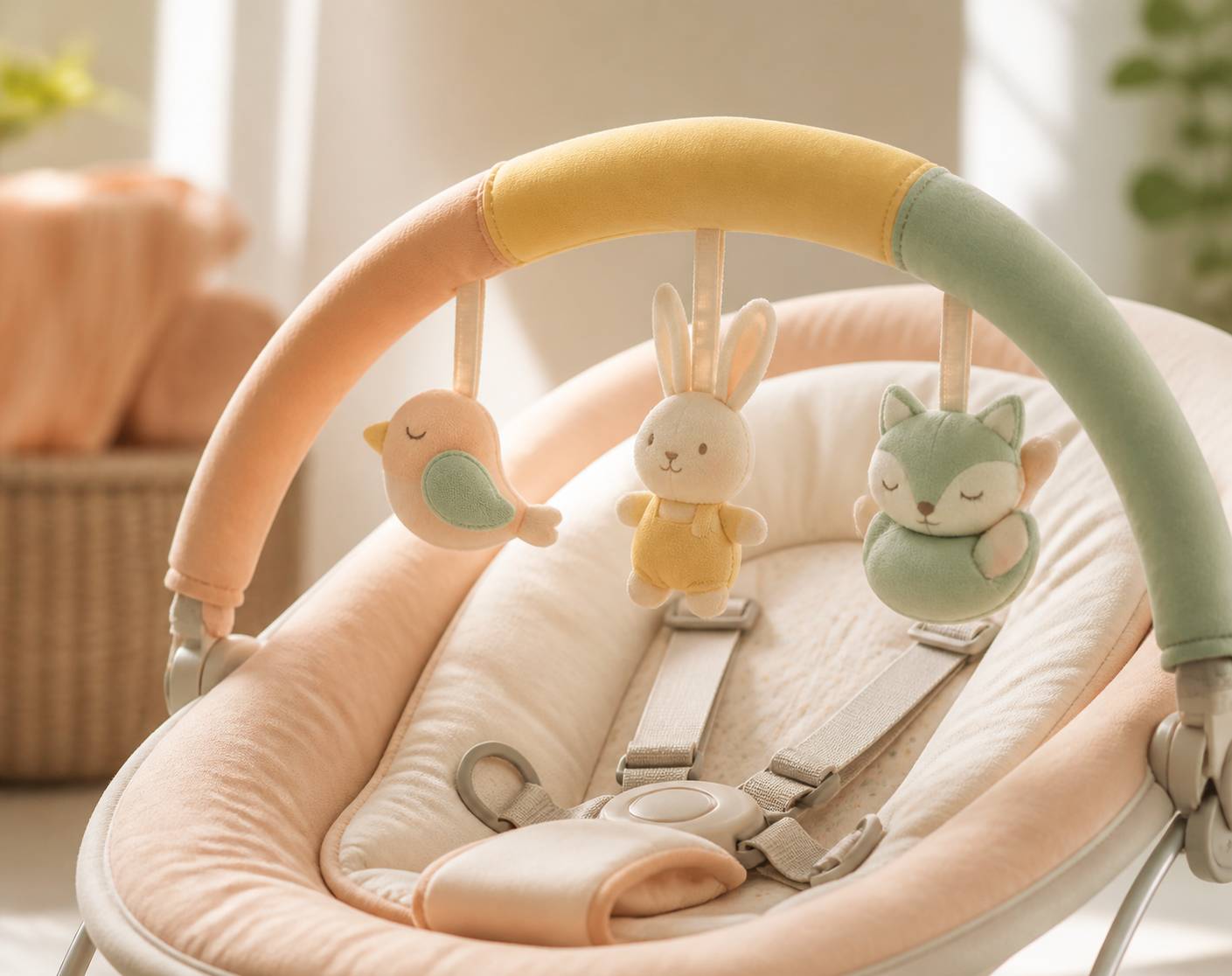
Important: never place a bouncer on an elevated surface (table, bed, couch). The bouncer must be placed on the floor on a stable, flat surface. Supervision is essential: an infant can roll over or slip if the harness is not properly fastened.
Bouncer safety checklist
- Confirm compliance with NF EN 12790 standard.
- Place the bouncer on the floor, away from dangerous corners.
- Check the condition of the 5-point harness before each use.
- Never add pillows or cushions that could obstruct breathing.
- Respect the maximum weight indicated by the manufacturer.
An illustrative case: at a party at friends’ house, Marc wanted to place Noé on a couch in his bouncer. A clear instruction from Léa prevented the incident: replace the bouncer on the floor. This simple gesture reminds us that attention counts more than adults’ occasional comfort.
Moreover, regarding soothing devices, the swing offers electric options and rocking speeds, but it introduces dependence on batteries and sounds. The bouncer remains silent, light, and often easier to maintain. Comparing advantages helps adapt the choice to family daily life.
To deepen safety and maintenance, a useful resource is the guide on childcare equipment which helps create a safe and comfortable environment for the child. Such articles put into perspective all the practical and safety needs of the household.
Insight: bouncer safety relies on simple and consistent rules: standard, floor placement, and active supervision.
Choosing your baby bouncer: models, bouncer materials, and parent tips for buying well
Choosing a bouncer involves a compromise between practicality, baby comfort, and durability. Families seek evolving options, easy to clean and light to carry. Models frequently cited by parents show varied profiles: ease of use, inclination adjustments, rocking options, and presence of a newborn insert.
Comparison of models and uses
Concrete examples: BabyBjörn is appreciated for its intuitive installation and solidity. Béaba’s Up & Down appeals to parents who want to adjust height so baby is at adult height. Doomoo nest offers a soft cocoon usable for a long time, even as a pouf up to 30 kg. Badabulle’s Easy Moonlight combines morphological head cushion and swing mode, practical to quickly soothe a restless baby.
Considering bouncer materials is essential: breathable fabric to limit sweating, foam free of VOCs for chemical safety, and removable covers for hygiene. Parents must also check ease of assembly and robustness of fastenings, especially if the equipment travels frequently.
Practical parent tips for purchase
- Prioritize a model with an insert if you intend to use it from birth.
- Test cleaning ease (machine washable if possible).
- Check compactness and weight if the bouncer will be moved often.
- Favor a 5-point harness and easy-to-adjust straps.
- Consider long-term use: evolving or planned replacement.
The guiding thread of this article relies on the illustrated family: Léa and Marc made their choices by testing in store, reading reviews, and following safety markers. Their pragmatic approach — test, compare, respect recommendations — avoids common regrets and simplifies daily life.
Insight: a good choice is based on matching household needs, compliance with standards, and ease of maintenance; the ideal bouncer combines bouncer safety, baby comfort, and parental practicality.
At what age can a bouncer be used for a newborn?
A suitable bouncer can be used from the first weeks if the model has an insert and allows the newborn’s curled position. Always check manufacturer recommendations.
How long should baby be left in the bouncer each day?
It is recommended to limit duration: ideally short sessions (20 minutes) and no more than one hour cumulatively per day. Alternate with a play mat to promote motor skills.
What are the essential safety rules for the bouncer?
Comply with NF EN 12790 standard, place the bouncer on a stable floor surface, fasten the 5-point harness, never leave baby unattended, and do not add pillows.
Bouncer or swing: which to choose to soothe baby?
The bouncer is silent, light, and without power supply, while the swing offers speeds and lullabies. The choice depends on soothing needs and practical constraints, without forgetting to limit usage duration.