The art of small gestures: Fine motor skills
From the first time they grasp your finger to the beginnings of writing, fine motor skills are the foundation of autonomy. Discover how to support every progress with gentleness and expertise in this year 2026.

Understanding Motor Skills:
Gross vs Fine
It is essential to distinguish between two pillars of a child's physical development that, while different, are intimately linked and nourish one another.
Gross Motor Skills
This involves large movements that engage the body's major muscles. Walking, running, climbing, or throwing a ball are part of it. It is the basis for balance and posture, themes that we explore in more detail on our dedicated page for Motor Skills and Body.
- Walking and Jumping
- Balance and coordination
- Postural tone
Fine Motor Skills
This corresponds to the precise, meticulous, and coordinated movements of small body parts, mainly the hands and fingers. It is the intelligence of the hand, capable of buttoning a jacket or wielding a pen. It is the key to daily autonomy.
- Pincer grasp
- Eye-hand coordination
- Digital precision
The hand's journey: Key milestones
From discovery to reflex
At first, movements are involuntary. You will notice birth reflexes like grasping. Around 3 months, baby starts to look at their hands, and around 6 months, they pass an object from one hand to the other.
Key moment: The appearance of the pincer grasp (thumb-index) between 8 and 10 months.
The precision explorer
This is the era of the first inset puzzles and pointing. Baby begins to scribble in a circular fashion. At 1 month, they only clenched their fist, now they stack their first cubes with pride.

Tool time
Eye-hand coordination sharpens considerably. The child begins to use scissors (round edges), thread beads, and draw closed circles. This is a crucial step for entering preschool.
Mastery and writing
Gestures become fluid. The child can lace their shoes, cut complex shapes, and begin learning cursive writing. Lateralization (choice of the dominant hand) is now well established.
Developmental Activity Simulator
Choose your child's age to discover game ideas tailored to their fine motor skills.
Select an age range above.
Preschool:
The springboard to writing
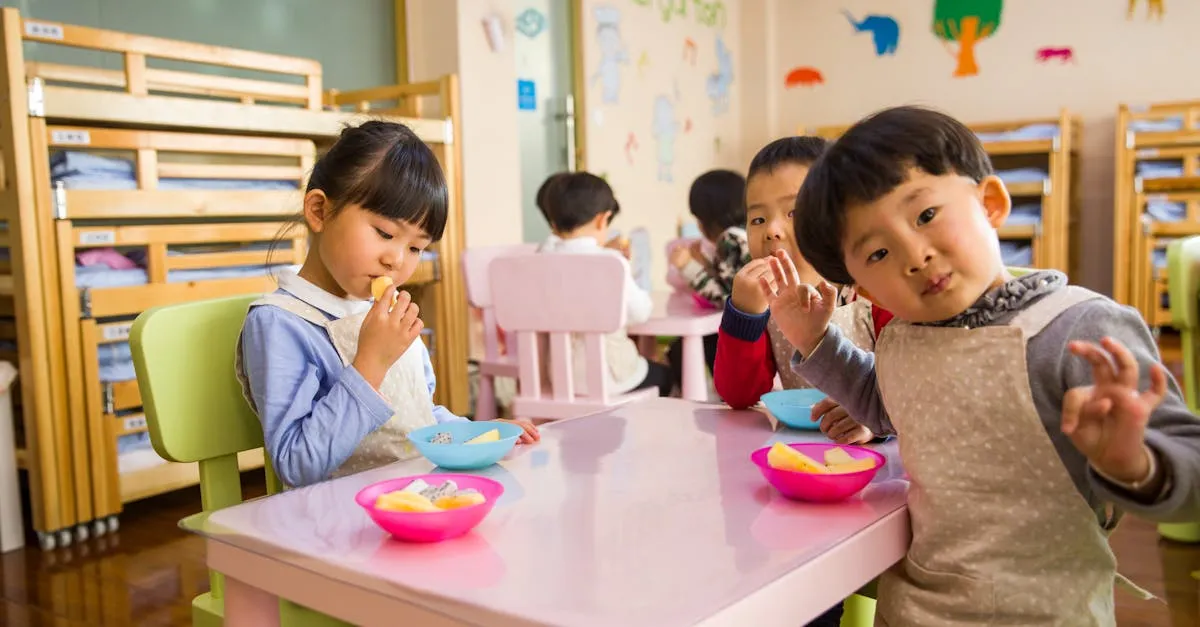
Fine motor skills are not just a creative hobby. In preschool, they are the foundation of academic success. A child who masters their hands is a child who will enter writing with confidence.
Pre-writing skills
Learning to draw lines, curves, and loops prepares the hand to form letters.
Tool handling
Scissors, glue, brushes: each tool requires a different grip and strengthens the hand muscles.
The Montessori Approach: "Help me to do it myself"
Maria Montessori gave a central place to the hand, which she described as the "organ of intelligence."
Practical Life
Transferring seeds with a spoon, pouring water, buttoning frames... everyday gestures that practice precision.
See sensory awakening →Sensory Material
Sandpaper letters or inset shapes allow touch to be associated with cognitive learning.
Discover permanence →Freedom of Choice
The child chooses their workshop and repeats it as many times as they wish. Repetition is the key to motor mastery.
When to worry?
Every child develops at their own pace; this is a golden rule. However, certain signs may indicate a need for specific support. Early detection is always beneficial for the child's comfort.
- Persistent difficulties using both hands in a coordinated way after age 3.
- Systematic avoidance of manual activities (coloring, puzzles).
- Excessive clumsiness leading to frequent dropping of objects or very abrupt gestures.
Professionals at your service
If you have a doubt, do not hesitate to consult specialists who can reassure you or suggest an appropriate care path (Dyspraxia, neurological disorders, etc.).
The Psychomotor Therapist
Works on overall balance and bodily ease.
The Occupational Therapist
Specialist in fine gesture rehabilitation and environmental adaptation.
The Graphotherapist
Specifically supports writing disorders (dysgraphia).
Parent Questions
My child is left-handed, is that a problem? +
Absolutely not! Handedness is generally set around age 4. Just provide adapted material (left-handed scissors) so they can develop fine motor skills just as effectively as a right-handed person.
How can I strengthen fingers for writing? +
Playdough is magic! Pressing, rolling, pinching, and cutting the dough strengthens the small intrinsic muscles of the hand. Clothespin games are also excellent.
Should pencil grip be corrected from the start? +
Gently encourage the "pincer" grip, but do not force it. Offer short chalks or triangular crayons that naturally induce the correct finger placement.
Support with love and patience
Fine motor skills are a marathon, not a sprint. By offering your child a rich, safe, and caring environment, you give them the keys to a peaceful future. Remember that play is their most serious work.

The La Vie de Bébé Team
By your side since the first days.