
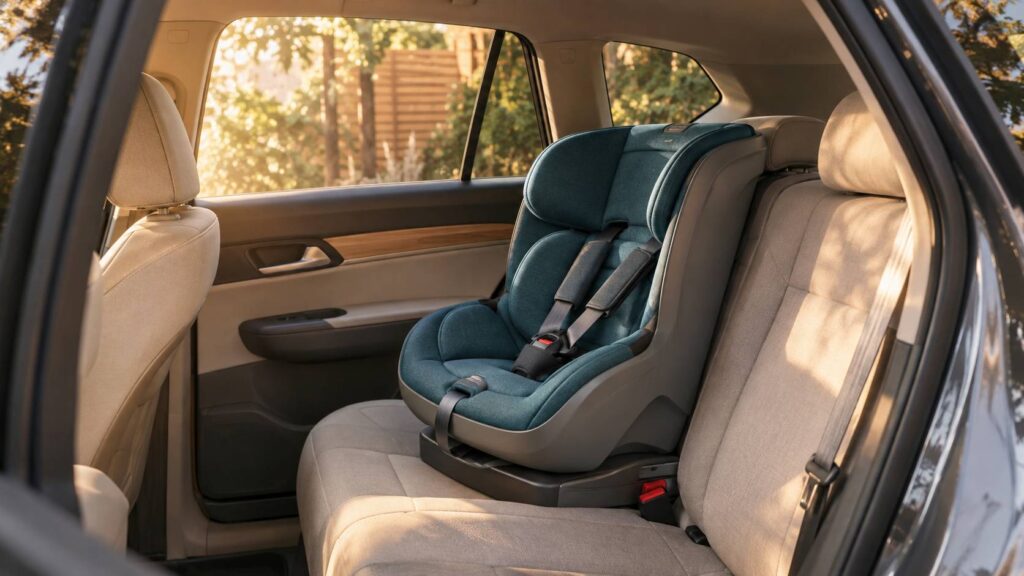
Mandatory Child Car Seats in Spain: Essential Rules for Transporting Baby by Car
The safety of the youngest passengers relies on clear rules and simple actions to be applied before each trip. In Spain, the regulation requires the use of a Child Restraint System (CRS) suitable for children measuring 135 cm or less. This requirement does not depend on the duration of the journey: a ten-minute trip requires the same precautions as a long trip.
The central principle is to adapt the device to the child’s actual size, not only their age. Modern devices are designed to position the seatbelt correctly or offer integrated protection, and their correct installation determines effectiveness in the event of an accident.
Positioning constraints and exceptions provided by the code
The general rule is that children subject to the CRS obligation travel in the rear seats. Three regulated exceptions exist: absence of rear seats, physical impossibility to install all necessary CRS units in the back, or full occupancy of rear seats by other children using appropriate CRS. In these limited cases, the child can legally be placed in the front, provided additional safety measures are respected.
An important technical detail concerns airbags: if a child is in the front seat in a rear-facing device, the passenger airbag must be deactivated. The deployment of an airbag exerts considerable force that can seriously injure a child, especially when they are oriented rear-facing.
Why the rule for rear seats?
Rear seats offer superior passive protection during frontal collisions, which are statistically frequent. Body systems, airbags, and seats are designed for adult morphologies; a child poorly positioned by the seatbelt can suffer concentrated forces on the neck or abdomen. The CRS serves to distribute forces over more robust areas and avoid sliding under the belt.
The logic is therefore twofold: reducing injury risk through a safer position and ensuring the effectiveness of restraint systems designed for adults through proper adjustment via the CRS.
Practical cases and checks before each trip
Before leaving, it is essential to check:
- that the device is approved and suitable for the child’s size and weight;
- that the installation is stable and does not move excessively;
- that the harness is well tightened, without unnecessary space between the body and straps;
- that the passenger airbag is deactivated if necessary.
These checks reduce stress and enhance safety. They constitute the first care action before starting.
Insight: complying with the CRS obligation and preferring the rear bench is the simplest and most effective measure to protect a child in a vehicle.

Choosing the Right Child Car Seat for Baby in Spain: Rear-Facing, Standards, and Adaptation
The choice of seat is made on precise criteria: actual morphology, seat approval standard, installation orientation, and vehicle compatibility. For infants and very young children, a rear-facing seat offers better protection for the head, neck, and spine.
Recent standards now favor classification by size rather than by age, which facilitates choice according to the child’s build. When renting or borrowing, it is therefore useful to provide the baby’s approximate size and weight rather than just their age.
Differences Between Infant Carrier, Convertible Seat, and Booster
Systems differ by design:
- Infant carrier/baby seat: intended for newborns and very young infants, often used rear-facing to absorb forces in case of impact.
- Convertible seat: switches from rear-facing to forward-facing according to the child’s growth; it accompanies several stages.
- Booster: for older children who no longer need a harnessed seat but require proper guidance of the adult seatbelt.
It is common for parents to simply say “seat” without specifying the type. This imprecision can lead to receiving an inappropriate accessory when renting. It is better to communicate concrete data: size, weight, and whether the child still travels rear-facing.
Adjustment Protocols and Common Errors
Three errors frequently occur: harness too loose due to a bulky coat, seatbelt badly positioned on the neck or abdomen, and seat poorly fixed to the ISOFIX anchor or seatbelt. Each error reduces the device’s effectiveness.
Recommended procedure: install the seat, adjust the harness without a thick coat, check for absence of excessive play, then perform a pull test at the base to ensure the seat is firmly fixed.
For trips with several stages, it is useful to have a clear routine: visual and tactile checks, harness adjustment, temperature control, and possibly a seat cover if the car heated up.
Insight: a suitable and well-adjusted seat transforms a passive device into real active protection for the child.
Booking a Car with a Baby Seat: Preparation, Information to Provide, and Best Practices
Booking a vehicle with a child seat requires anticipation. In high season, accessory availability may be limited; it is therefore recommended to specify needs at the time of booking. Providing precise information facilitates vehicle preparation and avoids unpleasant surprises upon arrival.
You must communicate at booking the number of children, their age, approximate height, weight, whether a rear-facing seat is needed, and if a stroller or travel cot will be carried. This information allows the agency to prepare a suitable vehicle and anticipate the required trunk space.
Practical List to Provide or Prepare Before Booking
- Number of children and approximate age.
- Approximate height and weight for each child.
- Type of seat needed: “infant carrier,” “convertible seat,” “booster.”
- Number of suitcases and presence of a stroller.
- Pickup location and time of the vehicle.
- Flight number if picking up at the airport.
This list helps the agency prepare the appropriate equipment and reduces the risk of error during handover. Arriving in a ready-to-use vehicle saves energy for the child rather than solving logistical surprises.
Checks at Vehicle Pickup
At the time of collecting the car, systematically check:
- the stability of the installed seat;
- the correspondence between the seat provided and the declared needs;
- the presence of an installation manual if needed;
- the deactivation of the passenger airbag if a rear-facing seat is placed at the front.
If there is any doubt about the installation, immediately ask for demonstration or assistance. A quick adjustment in the parking lot avoids unnecessary stress on the road.
Insight: precise information at booking is the best guarantee of a calm and safe journey with baby.
Organizing Short and Long Trips with Baby: Comfort, Breaks, and Practical Tips in the Car
Traveling with a baby changes the daily organization of the trip: breaks, diaper changes, hydration, and temperature management on board must be planned. Safety through the CRS remains the priority, but comfort optimizes the experience for everyone.
Even for short trips, the seat must be used. Roads may have curves, sudden braking, or uneven surfaces; absence of a CRS multiplies risks. Systematic use of the seat establishes a routine that limits forgetfulness.
Tips for Comfort and Safety During the Trip
Some practical gestures:
- avoid thick clothing under the harness;
- provide a breathable seat protector to avoid discomfort during hot weather;
- keep snacks and water within reach for breaks;
- plan stops every 1 to 2 hours to change, feed, and relax the baby;
- use a light blanket rather than a thick coat for the harness.
The car should be chosen for practical qualities: sufficient trunk space, easy access to rear seats, and ISOFIX anchors if available. It is better to prioritize space rather than economy if it makes the trip more comfortable and less stressful.
Typical Day Organization for an Excursion
For a day out, plan according to the baby’s needs: departure after a nap, a stop for a meal, and a return before nightfall if the child is sensitive to time changes. Too long trips without breaks increase irritability and fatigue risk.
A small practical scenario: early departure, stop to change and stretch after an hour, meal break and a one-hour nap, then visit a nearby location accessible on foot with a stroller. This format limits road constraints and maximizes family enjoyment.
Insight: considering safety and comfort as two sides of the same coin makes it possible to organize calm and adapted outings according to the baby’s rhythm.
Insurance, Responsibilities, and Practical Resources for Parents Transporting Baby in Spain
Travel also involves verifying contractual and insurance aspects. Before leaving, consulting rental conditions (liability, insurance, options without excess) allows anticipating unforeseen events and traveling more calmly.
Drivers are responsible for complying with CRS-related rules and the securing of young passengers. In case of police checks, absence of an appropriate device or incorrect installation may lead to sanctions and, above all, compromise the child’s safety.
Useful Resources and Knowledge Verification
For those wishing to deepen knowledge of driving licenses and road regulations, the site autoescuelasancarlos.es serves as an independent editorial guide in Spanish on the B license and points system in Spain; it can help understand certain license steps or verify rules related to driving and safety.
Consulting rental agency documentation and carefully reading general conditions avoid unpleasant surprises related to extras such as child seats, delivery, or fees in case of damage.
Summary Table: Roles and Responsibilities
| Actor | Main Responsibility | Recommended Action |
|---|---|---|
| Driver / Parent | Ensure correct installation of the CRS | Check harness, fixation, and airbag deactivation if necessary |
| Rental agency | Provide a suitable seat upon request | Confirm seat type and prepare the vehicle in advance |
| Insurer | Coverage in case of incident | Check options without excess and extent of coverage |
In case of doubt during a trip, stopping to reevaluate the installation is the best decision. Prevention and vigilance remain parents’ best allies.
Insight: good administrative preparation and verification of guarantees strengthen peace of mind and safety when traveling with baby.