Choosing a soft and safe wool for baby: fibers, feel, and selection criteria
The starting point for successful baby knitting is the choice of wool. The fabric must first be comfortable, then easy to care for, and suitable for still sensitive skin. Parents want softness without sacrificing practicality: a material that remains beautiful after several washes, doesn’t felt too much, and doesn’t irritate.
The choice between a so-called natural fiber and a synthetic fiber depends on the project and daily life. A natural fiber often offers a warmer and more breathable sensation, appreciated for clothing intended for rest times. A synthetic fiber can facilitate care and better withstand repeated washing, which is practical for clothes worn daily.
Signs to look for to recognize suitable wool
To the touch, you should look for a soft and smooth feeling. Rough or prickly wool is less suitable for a newborn’s fragile skin. The label or product description sometimes indicates mentions of softness or hypoallergenic treatment; these indications, combined with the tactile sensation, guide the choice.
Skin reaction is another criterion. If, after a test, the baby’s skin shows redness upon contact with the fabric, it is better to change the material. A common anecdote in consultations shows that a parent places a small knitted square on the skin and observes over time: if the area remains calm, the fiber is generally acceptable.
Care and safety: what wool must allow
A yarn intended for baby knitting must allow simple care. Some yarns can be machine washed without felting, others require hand washing. The important thing is to anticipate the frequency of use. A garment that will be worn often deserves a fiber that tolerates washing well.
In terms of safety, prioritize fibers that don’t deform and solid finishes. Fragile accessories or decorative elements that may come off are to be avoided. Seams must be flat and edges firmly fixed to limit snags and risks of ingestion.
Concrete examples and situations
A parent pressed by short nights often chooses an easily maintained fiber for everyday pieces. Another family prefers to invest in a very soft natural fiber ceremony sweater, reserved for special occasions, to limit exposure to frequent washing.
A common case: a knitted hat for an anticipated outing. If the baby seems comfortable wearing the hat for a short walk, the material is suitable; if the skin shows marks or if the baby moves less freely, the yarn will need to be changed or the yoke revised.
To get oriented, here are some essential criteria to keep handy:
- Feel: must be soft and non-irritating.
- Care: favor yarn that is easy to wash.
- Durability: robust finishes and flat seams.
- Safety: avoid detachable elements and fraying yarns.
In practice, when the choice is doubtful between two yarns, test a small sample directly on the skin, then wash it according to usual practices: observation before and after reveals the stability of the material. This simple gesture avoids many disappointments and provides an initial emotional security: the garment soon becomes a source of comfort rather than worry.
Insight: choosing wool primarily means prioritizing comfort and safety — the rest is settled by the project and intended use.
Understanding sizes and adapting knitting to the baby’s body: practical methods
Adapting a pattern to the baby’s body is based on observation rather than abstract numbers. The usual categories are described in terms of stage: newborn, small, medium, and large. Each category corresponds to a morphology and concrete adjustments to apply to the knitting.
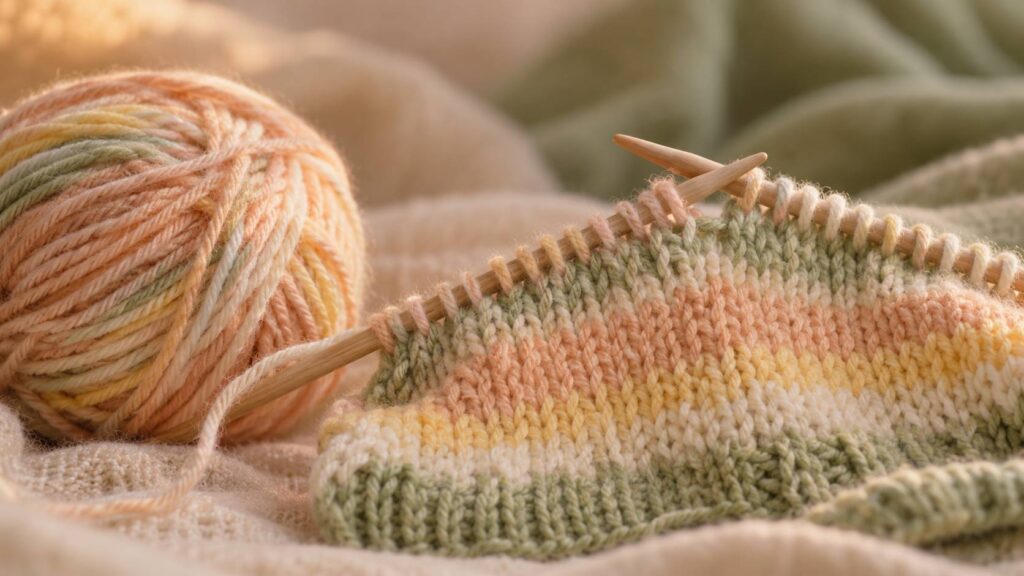
The basic tool to ensure a good fit is making a swatch. Rather than looking for an exact number of stitches, it involves producing a reference square with the same yarn and needles, then checking the drape and fall. If the resulting fabric seems tight, the solution is to opt for larger needles; if it seems loose, finer needles structure the stitch better.
How to measure and adjust without complicated numbers
Observing the feel and shape is often more useful than counting. For example, for a cardigan, check that the ease around the torso allows free arm movement without too much fabric on the belly. For a hat, testing elasticity at the base ensures the accessory stays in place without squeezing.
A practical tip in the workshop: knit a small piece identical to the stitch used for the garment and lay it on a flat surface. Visually comparing the drape and density with a baby garment already used helps anticipate the final result. This simple process allows adjusting yarn tension before starting a long project.
Qualitative comparative table of sizes and quantities
| Category | Body profile | Amount of yarn | Recommended needles |
|---|---|---|---|
| Newborn | Very fine silhouette, compact pieces | Low | Fine |
| Small | Delicate silhouette with slight ease | Moderate | Medium |
| Medium | More pronounced proportions, need for freedom | Moderate to high | Medium to thick |
| Large | More generous pieces, attentive to movements | High | Thick |
This table provides a quick and qualitative reading. In workshops, it is common to adapt the structure to the family: if the baby often wears thick diapers or suits, prefer wider ease; if the clothes are intended for home and naps, a close fit is often more protective against cold.
Before starting knitting, it is recommended to list the main steps: yarn choice, swatch testing, needle adjustment, and trying a sample piece. This process reduces stress and avoids lengthy rework.
A useful guideline in the workshop is observing a living object: placing a sample garment on a cushion and simulating the movements the baby will make. This helps visualize wear zones and strengthen, from cutting, the areas that will be most stressed.
Insight: the right size is guessed by observation and testing; the swatch is the most reliable tool to ensure an appropriate drape.
First easy models: hat, booties, and simple cardigan explained step by step
Starting with simple models allows quick and rewarding results. The most accessible projects often require basic shapes without complex seams. Three models open the way well: a soft hat, easy booties, and a simple assembly cardigan.
The hat is a comforting first project. The idea is to work a tubular piece whose height and elasticity are adjusted by the chosen stitch. Knitting in short rows or in the round depends on the knitter’s ease and the desired result. For a soft finish, prefer a wide rib edge that holds without tightening.
Practical steps for an accessible hat
The general method follows a logical sequence: choose a flexible cast-on, work a few smooth patterns for the hat’s body, then gradually reduce the size toward the top for a harmonious closure. Decreases are made spaced out to keep fabric regularity. A common anecdote in workshops: a parent realizes that varying a simple stitch completely transforms the appearance of the hat, making the project very customizable.
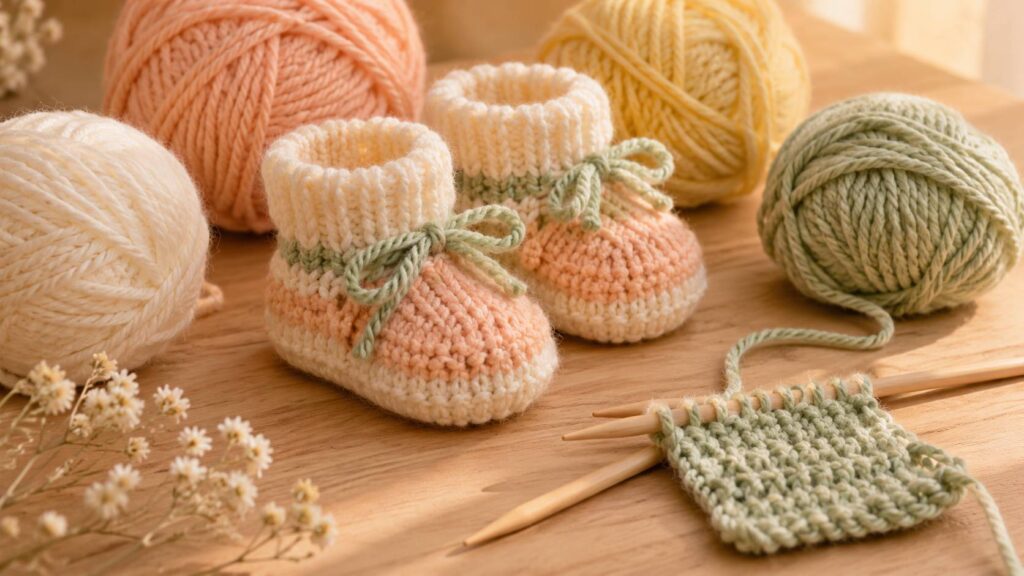
For booties, simplicity and support are essential. The ideal pattern combines a slightly structured sole and a flexible body that surrounds the foot. Flat finishes and internal seams prevent irregularities and enhance comfort. The trick is to test the bootie on an approximate foot model before finishing: if it slips too much, tighten the ankle; if it seems tight, add a comfort stitch.
Simple assembly cardigan: techniques and tips
The cardigan with classic armholes avoids complicated seams. It is often knitted in easy-to-assemble pieces: back and fronts combined by a light seam. Stockinette stitch or a simple textured stitch gives a nice drape and facilitates realization. Edges can be worked in directional bands for regular hold.
A guiding principle for these projects is the repetition of a calm gesture, like rhythmic breathing. A parent will report that knitting the hat quietly made the gesture a soothing moment, and the finished object became an emotional talisman for first outings.
- Essential tool: comfortable needles and a pair of blunt tip scissors.
- Finish: use a tapestry needle to neatly weave in ends.
- Fitting: always check the fit before weaving in all ends.
In practice, starting with these models allows mastering key gestures: casting on, knit stitch, decreases, and invisible finishing. Each completed project boosts confidence and enables tackling more technical pieces afterward.
Insight: choosing a simple model allows obtaining a useful garment quickly, while practicing the gestures that will build confidence.
Safety, finishing, and care of baby knits: practices to adopt
Textile safety for babies starts with careful finishing and choosing elements that do not come off. Buttons or decorations must be replaced by secure alternatives if their attachment is not perfectly solid. Seams must be flat and edges firmly fixed to avoid fibers catching on fingers or objects.
Care is a crucial part. Knits must withstand frequent washing without losing their shape. Washing advice should be simple: favor gentle cycles, dry flat to preserve shape and avoid tension. Aggressive products must be avoided as they damage the fiber surface and can make the knit less comfortable.
Finishes that last
Finishing gestures increase a piece’s durability. A neatly tucked edge, reinforced seams in stressed areas, and controlled blocking after washing preserve shape. Assembly threads must be chosen to be flexible but strong; too fine a thread risks breaking, too thick a thread can stiffen the garment.
To repair a small snag, favor a clean and discreet fix. A useful example: if a filament comes loose, picking it up with a few stitches inside the piece prevents the snag from spreading. Simple repairs are helpful and reduce waste.
During workshops, it is advised to prepare a care kit containing a repair tool, a wool needle, and a soft brush for the fiber. These tools accompany daily use and allow quick action when a small incident occurs.
Finally, for those wishing to deepen the calculation of the required yarn quantity or learn to repair a sewn garment, a local and specialized resource exists to guide toward practical guides and adapted calculators. For concrete help in yarn choice and calculating needs, consult fil-et-couleurs.fr which provides tools and advice directly linked to knitting.
List of safety and care recommendations:
- Secure attachments: avoid detachable elements not reinforced.
- Flat seams: for comfort and robustness.
- Gentle washing: protect shape and softness.
- Dry flat: avoid deformation by stretching.
- Quick repairs: fix a snag as soon as it appears.
Insight: careful finishing and proper care extend the life of a knit and reinforce its emotional value.
Knitting for baby: emotional benefits, soothing gestures, and transmission
Beyond the object, knitting for a baby is a meaningful act. Making a garment weaves a story between the knitter and the baby. Moments devoted to knitting often serve as spaces for relaxation and reflection, precious resources for sometimes tired parents.
The guiding thread of these experiences is the repetition of a thoughtful gesture. Holding the needles alternately with breaks transforms the creation into a soothing ritual. Parents recount that a hat given for a first outing becomes a landmark, a security signal bearing the trace of the attention that made it.
Ritual and transmission
Giving a knit is passing on a portion of time and care. The piece often becomes a family archive, kept for memories or used as an example when the baby grows. Some families share these creations during gatherings between generations, creating a symbolic thread across ages.
Knitting can also be adapted as a soothing tool: knitting near the baby during quiet hours offers a regular background noise and reassuring presence. The repetitive movement, the yarn texture, and the object in progress contribute to a peaceful atmosphere.
Practical tools to keep within reach
To facilitate the activity and make it accessible, it is useful to have a compact kit near a comfortable chair. This kit will include suitable needles, a pair of blunt tip scissors, a wool needle for finishing and repairs, and a swatch of the yarn used. A simple routine increases the likelihood of finishing projects and maintaining motivation.
Here is a compact list of tools and items to keep within reach:
- Comfortable needles adapted to the chosen yarn.
- Scissors safe for use near a baby.
- Wool needle for finishing and repairs.
- Swatch of the yarn to adjust tension if necessary.
Finally, knitting for a baby is also a way to educate in patience and creativity. The finished pieces become storytelling supports: narrating how they were made enriches the object with meaning and creates bonds. This simple, repeated gesture is part of transmitting a calming know-how, useful for daily parenting.
Insight: knitting is not only useful: it is a relational practice that contributes to the well-being of both baby and parents.