In brief:
- 20 step-by-step DIY ideas to offer personalized gifts to kindergarten teachers.
- Practical advice on the right moment to give the gift and the etiquette to follow in class.
- Material sheets, safety tips, and group alternatives to simplify organization.
- Concrete examples from Lucas’s class to inspire parents and encourage creativity.
- Additional resources and tutorials for wrapping, personalized cards, and enhancing the thank-you gesture.
20 personalized DIY gift ideas to thank kindergarten teachers
Giving a gift at the end of the year is often a symbolic gesture of appreciation. For kindergarten, handmade personalized gifts have strong emotional value and allow the child to be an active participant in the thank-you.
Here is a detailed list of 20 DIY ideas, each accompanied by a small practical instruction to involve the child while respecting their age and motor skills.
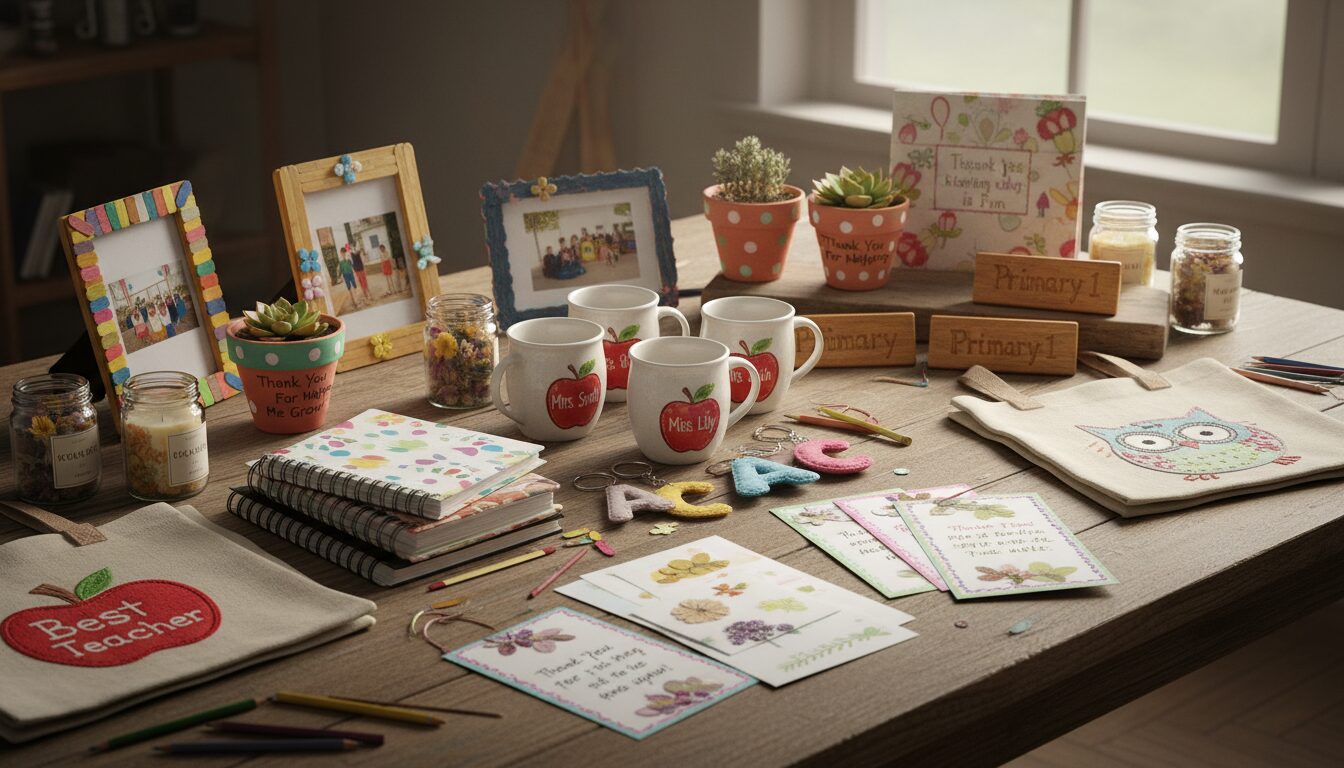
- 1. Photo frame decorated with the child’s hands — Non-toxic paint, handprints, then insert a group photo.
- 2. Bound drawing booklet — Gather drawings from the year, staple or bind to create a memory book.
- 3. Customized pencil holder — Painted and varnished terra-cotta pot, label with class name.
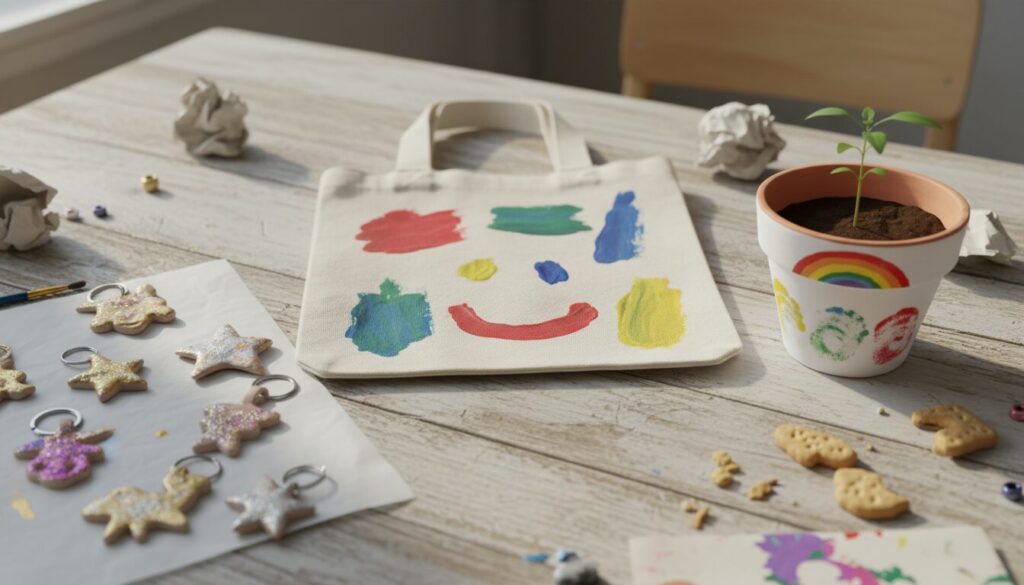
- 4. Painted tote bag — Textile paint and stencils made by the children.
- 5. Decorative candle (secured) — Candle in a jar, personalized label (attention to classroom use).
- 6. Scented handmade soap — Simple cold process soap or kits for children under supervision.
- 7. Personalized door plaque — Light wood painted, handprint, and collective message.
- 8. Relaxation kit (teas/infusions) — Small sachets with a drawn label.
- 9. Magnetic board with photos and drawings — Painted MDF, magnets decorated by the children.
- 10. Polymer clay keychains — Small baked shapes (made by parents if necessary).
- 11. Miniature potted garden — Easy-care plants + “thank you” card.
- 12. Illustrated bookmarks — Ideal if the teacher likes reading; personalized by each child.
- 13. Class photo calendar — Monthly photos or drawings turned into a calendar.
- 14. Decorated memory box — Cardboard box covered with collages.
- 15. Painted scarf or shawl — Textile paint, simple patterns.
- 16. Decorated cookie jar — Jar filled with homemade cookies, with a label made by the child.
- 17. Collective “thank you” poster — Large poster displaying a word from each child.
- 18. Creative workshop kit — Small pots of paint and brushes, prepared and labeled.
- 19. Handmade pop-up card — Simple folding technique to surprise.
- 20. Personalized playlist — Compilation of songs worked on in class, provided on USB key or QR link.
Each suggestion promotes emotional connection and can be adapted to available time and budget. For example, Lucas’s class chose the photo frame and the collective poster: a parent took charge of the binding while the children decorated and signed each item. This choice strengthened cohesion between the family and the school.
To make the gift a genuine thank you, it is appropriate to add a card written by the child — even a simple “thank you” written or drawn will suffice.
Insight: favoring projects that involve fine motor skills and emotional expression creates a useful and meaningful gift.
When and how to give an end-of-year gift to the teacher: timing and etiquette
Choosing the right moment to give a gift matters as much as the gift itself. There are several natural occasions for this gesture, each with its own codes.
The most common moment is the last day of class. It is symbolic and allows the child to participate in the final contact before the holidays. In this context, giving the gift directly to the teacher or entrusting it to the team allows a warm and simple handover.
Alternatives to the last day: parties, meetings, and exchanges
If the school organizes an end-of-year party, the friendly atmosphere may encourage a collective gift presentation. However, discretion is advised: if an individual gift is planned, it is better to give it at a time where it does not make other children uncomfortable.
An individual meeting, such as an assessment interview, is also appropriate. It allows accompanying the gift with a more personal word, highlighting a particular aspect of the teacher’s work.
Politeness rules and group gift alternatives
Several parents may choose a collective gift to simplify organization and offer something more expensive. This approach is practical and often appreciated.
Some practical advice: organize a clear collection (amount per family), choose a useful gift for the school or the person, and include a card signed by all. Reminding that intention matters most avoids any feeling of comparison or pressure.
For inspiration from simple DIY projects, it is useful to consult resources on handmade gift ideas, which offer variations adapted to different ages and availabilities.
Concrete example: in Lucas’s class, the parents organized a fundraiser and bought a nice set of educational supplies, accompanied by a poster signed by all the children. The teacher was touched by the simplicity and coherence of the gesture.
Insight: choosing the right moment and a thoughtful presentation enhances the meaning of the thank-you without causing discomfort among families.
Handmade gift ideas and creative workshops adapted to kindergarten: instructions and safety
“Handmade” projects must be designed for children’s safety, enjoyment, and success. Non-toxic materials, short steps, and appropriate supervision are essential.
Here are three ideas framed by clear steps, followed by practical tips for running a workshop smoothly.
Workshop 1: Decorated pencil holder
Materials: terracotta pot, non-toxic acrylic paint, food-grade varnish, brushes, ribbons. Steps: paint a base, let dry, add handprints or small patterns with stamps, varnish. Duration: 30–45 minutes.
Educational tip: assigning a simple task to each child (painting a zone, stamping a pattern) encourages mutual help and values collective results.
Workshop 2: Bound drawing booklet
Materials: A4 sheets, cardboard for cover, stapler or simple binding, glue, stickers. Steps: select drawings, arrange chronologically, assemble and decorate the cover. Duration: 40–60 minutes.
Developmental benefit: sorting and choosing drawings engages judgment and communication, useful for preparation for primary school.
Workshop 3: Pop-up card
Materials: cardstock, child-safe scissors, crayons, glue. Steps: fold base, cut a simple shape for the relief, decorate the outside. Duration: 20–30 minutes.
Support advice: prepare templates for younger children to ensure success and pride.
Summary table of materials, duration, and estimated cost:
| Project | Main materials | Duration | Estimated cost |
|---|---|---|---|
| Pencil holder | Terracotta, paint, varnish | 30–45 min | 5–10 € |
| Drawing booklet | Paper, cardboard, glue | 40–60 min | 3–8 € |
| Pop-up card | Cardstock, crayons | 20–30 min | 1–3 € |
These workshops promote creativity, fine motor skills, and a sense of belonging. They also offer a great opportunity to involve volunteers or available parents.
Insight: a well-prepared workshop guarantees a successful and rewarding gift for each child.
Themed sets and group gifts: organizing a class thank-you
Group gifts make it possible to offer something useful and meaningful without putting financial pressure on each family. Thinking in themed sets facilitates choice and coordination.
Examples of sets: “Tea/coffee break,” “Educational supplies,” “Relaxation and well-being,” “Creative workshop.”
Step-by-step organization
Step 1: propose options to parents via a clear message, specifying budget, deadline, and collection manager.
Step 2: validate the collective choice (e.g., wellness set) and distribute contributions.
Step 3: assemble the set the week before the end of the year, include the card signed by the children, and plan neutral but neat wrapping.
Roles and responsibilities
Appointing a coordinator simplifies the process. This role can be held by a volunteer parent; they centralize purchases, prepare the wrapping, and ensure the handover is discreet and collective.
If the collective option is not desired, another alternative is to offer a gift to the class (new book, educational game) in the name of all parents.
To find other ideas for craft activities to offer or adapt, resources on intergenerational activities can provide new leads. For example, drawing inspiration from activities designed for grandparents can offer simple and touching making ideas: creative activities for grandmothers proposes approaches to adapt for the teacher.
A warning: always check for allergies (food products, perfumes) and the school’s policy regarding objects that can be used in class.
Insight: a well-thought-out themed set is a strong, elegant, and practical collective gesture.
Wrapping, message, and staging: personalize the thank-you to make it touching
Wrapping and the card turn a useful object into a truly emotional souvenir. Some tips help care for the presentation without complexity.
Start with a card where each child leaves a word, a drawing, or a handprint. Short and sincere messages work best, especially in kindergarten. Example of a simple phrase: “Thank you for helping us grow.”
Easy and elegant wrapping techniques
Use recycled kraft paper, a colored ribbon, and a label drawn by the child. For a set, provide an inner pouch to protect fragile items. For a group gift, a large signed card reinforces shared recognition.
If the wrapping includes a food item, add a label listing ingredients for safety.
Staging the gift handover
Some options: ask the child to give the gift on behalf of the class, organize a short collective word during a gathering, or simply place the gift on the desk with the card for a more discreet moment.
Lucas’s class opted for a brief and prepared moment: each child said a word, the teacher received the set and the card, creating a warm moment without overloading the end of the day.
Finally, consider follow-up: a later thank-you message from the teacher (when she wishes) completes the recognition circle and values the families’ gesture.
Insight: neat wrapping and a sincere word transform a useful object into a lasting memory.
When is it preferable to give a gift to the teacher?
The most common moments are the last day of class, the end-of-year party, or during an individual meeting. The important thing is to avoid any competition between parents and to favor discretion if the gift is individual.
How to involve children without overwhelming them?
Choose tasks appropriate to the age: painting, handprints, simple cutting. Prepare the steps in advance and distribute roles so that each child contributes without frustration.
Should certain types of gifts be avoided?
It is recommended to avoid potentially dangerous gifts (sharp objects), scented items if there are allergies, and to check the school rules regarding food or objects used in class.
Simple idea for a collective gift with a small budget?
A themed set (tea/coffee break, educational supplies) assembled by parents allows offering something useful and elegant without a high cost per family.