
In brief:
- Overview of Walt Disney princesses, from Snow White to Raya, shedding light on their role in children’s imagination.
- Categories: traditional princesses, modern, warrior heroines — understanding what each type conveys.
- Practical advice for parents: selection of animated films, co-viewing, reference points for toddlers.
- Activities to suggest after the film: symbolic play, reading, soothing rituals inspired by magical kingdoms.
- Values and evolution: how Disney’s legacy has transformed to reflect models of emancipation.
Walt Disney princesses: portraits and Disney heritage in the enchanted universe
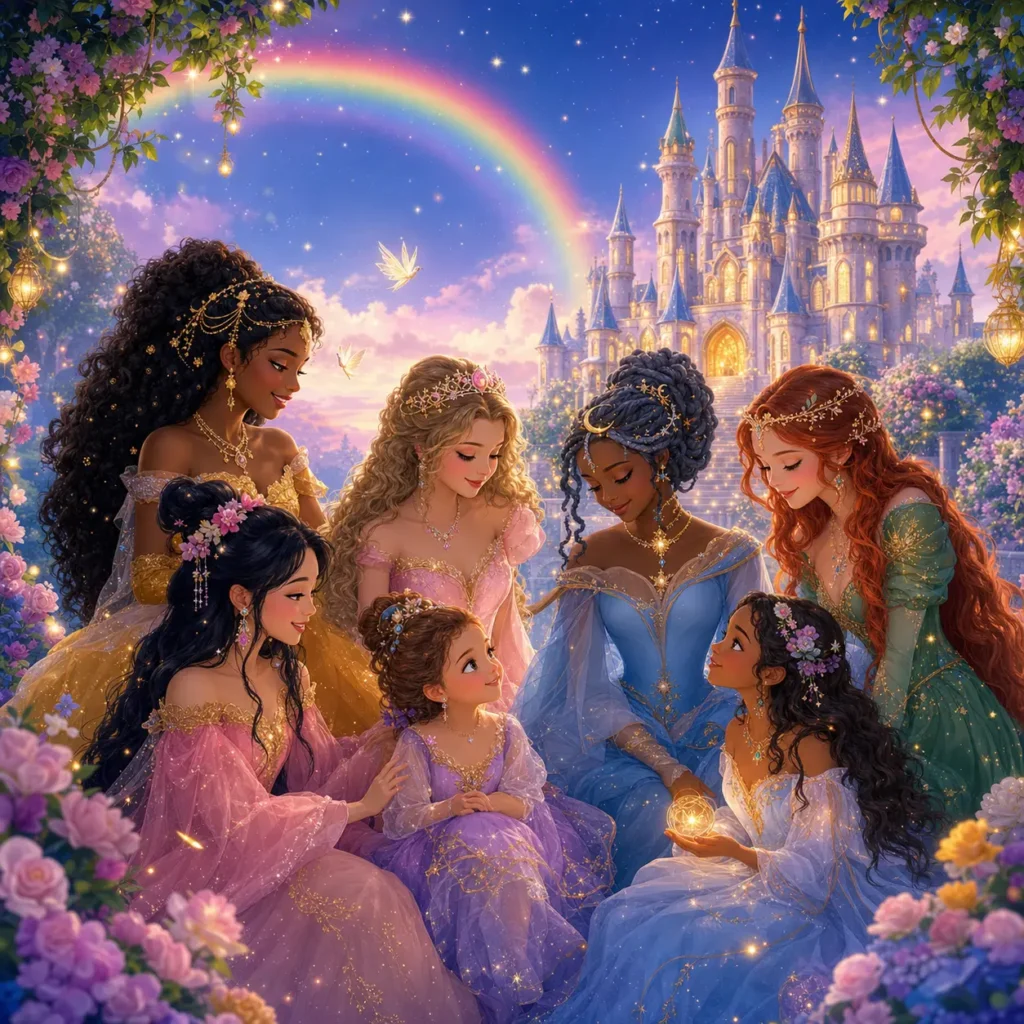
Walt Disney princesses form a rich and varied group spanning generations. From Snow White, created in 1937, to Raya released in 2021, these characters have become cultural landmarks and sources of wonder for children and their families. In this enchanted universe, each heroine carries a palette of traits — gentleness, rebellion, combativeness — which allow for a sensitive approach to the emotional development of toddlers.
From a perspective useful for parents, it is important to distinguish three major families of princesses: traditional princesses (Snow White, Cinderella, Aurora), modern princesses (Ariel, Belle, Jasmine), and warrior and heroine princesses (Pocahontas, Mulan, Tiana, Rapunzel, Merida, the sisters of Arendelle, Moana, Raya). Each conveys different images and stories that influence children’s identification and symbolic play.
For example, the first heroines, often described by their beauty and gentleness, encouraged a passive model where salvation came from a prince. These stories are historical and reflect the norms of their time. Conversely, modern princesses become actors of their destiny: Ariel leaves the ocean to explore the human world, Belle chooses her path despite local pressures, Jasmine refuses an imposed marriage.
For the Martin family, the main characters of this article, these distinctions helped choose films adapted to the age and questions of their daughter Clara. At 4 years old, Clara is fascinated by dresses and songs; at 7 years old, she begins to ask questions about courage and autonomy after seeing Mulan or Moana. Understanding this transition helps parents support emotions and offer constructive discussions after the session.
Educationally speaking, Disney’s heritage can be viewed as a tool: it can serve to reinforce empathy, encourage verbal expression, and stimulate imagination. The fairy tales contained in these films offer simple emotional situations — jealousy, courage, loss, success — that children can assimilate and reenact. For a concrete example, after watching “Beauty and the Beast,” a child can reinterpret fear of the unknown by comparing it to meeting the Beast, thus verbalizing their own worries.
Finally, it is essential to remember that the magic of magical kingdoms does not erase the role of adults: parents and early childhood professionals remain indispensable guides to put words on images. Watching the film, followed by a caring conversation and playful activities, transforms a simple session into a moment of emotional learning. Insight: Disney princesses constitute a powerful emotional mirror — used with intention, it becomes a tool for the child’s growth.
How fairy tales and Disney characters shape toddlers’ imagination
Fairy tales presented in animated films act as early narrative tools for the child. They provide simple patterns: a hero, a conflict, a resolution. In childhood, these structures help organize thought and develop causal understanding. For example, when a child sees Pocahontas trying to avoid war, they perceive complex notions — negotiation, empathy, responsibility — translated into accessible images.
On an emotional level, Disney characters become symbolic attachment figures. Many children project their fears and desires onto these heroines. Clara, from the Martin family, used the Rapunzel plush as “courage” during a doctor’s visit: a concrete illustration of how a character can serve as an emotional resource. Parents can reinforce this strategy by recalling the character’s courageous behavior and linking this model to the child’s experience.
Contemporary animated films also promote diversity of roles: in Mulan, the child sees a heroine who renounces gender expectations; in Tiana, the example of work, ambition, and perseverance is strong. These stories provide material for constructive discussions on values: respect, courage, importance of mutual aid. Parents can take advantage of these opportunities to ask open questions: “What would you do in Tiana’s place?” or “What did Merida learn by trying to be free?”
A practical point: the child’s age guides the level of explanation. With a baby or toddler, the presence of musical and visual elements is enough to create an emotional bond. For a preschooler, short and reassuring explanations help name emotions. For older children, one can begin reflections on injustice or sacrifice, using examples taken from films.
Finally, the magic created by these films is not neutral: it invites reflection on stereotypes. The evolution from Snow White to Raya shows a trajectory toward models of emancipation. By accompanying viewing with caring exchanges and creative activities, parents provide the child with a safe framework to decode these messages. Insight: Disney fairy tales are emotional learning supports that must be anchored through speech and play.
Choosing suitable animated films: practical guide and reference points for parents
Choosing a film in the enchanted world of Walt Disney princesses requires some simple reference points. The starting point is the child’s age and sensitivity. Younger children react strongly to intense images and separation scenes; therefore, it is advisable to opt for gentler stories or to anticipate parental support. For example, the soothing music and songs of “The Little Mermaid” often appeal to toddlers, while tense scenes in a film like “Mulan” may require discussion after viewing.
Here is a concrete and practical list to keep in mind before starting a film:
- Check the level of emotional intensity: action scenes, separation or threat.
- Encourage co-viewing for children under 7 to explain and reassure in real time.
- Use characters as educational levers: talk about positive qualities (courage, curiosity) and possible mistakes.
- Prepare an activity after the film (drawing, role play) to help the child express what they felt.
- Adjust duration: prefer split viewing if the child is very young.
To help parents, here is a synthetic table listing some princesses, their film, and the main themes to explore after the session. It makes it easier to choose according to the values one wants to work on with the child.
| Princess | Film | Year | Themes to explore |
|---|---|---|---|
| Snow White | Snow White and the Seven Dwarfs | 1937 | Gentleness, security, danger and trust |
| Cinderella | Cinderella | 1950 | Kindness, hope, limits of waiting |
| Belle | Beauty and the Beast | 1991 | Curiosity, judgment on appearance, responsibility |
| Mulan | Mulan | 1998 | Courage, identity, non-conformity |
| Moana | Moana | 2016 | Quest, community responsibility, exploration |
| Raya | Raya and the Last Dragon | 2021 | Trust, collaboration, reconciliation |
To further illustrate this film choice, the Martin family tested two approaches: first, structured co-viewing (pause for questions every 15 minutes), then free viewing followed by a creative activity. Both work; the choice depends on the child’s temperament and available time.
In practice, a few simple gestures make the difference: prepare a comforting cushion, anticipate potentially frightening scenes, and above all, offer a moment of discussion after the film. These small attentions transform the session into a learning opportunity. Insight: thoughtful selection of an animated film maximizes its educational potential.
Activities and games inspired by magical kingdoms: practical ideas for home
After the screening, offering activities helps anchor learning and nourish the imagination. Symbolic games, creative workshops, and daily rituals can draw inspiration from fairy tales and Disney characters to support socio-emotional development.
Activity 1 — Guided role play: invite children to replay a scene, but changing the end. This encourages creativity and decision-making. For example, if Clara reenacts the meeting between Belle and the Beast, we ask her to imagine another way to establish trust between the characters. This type of variation develops empathy and problem solving.
Activity 2 — Emotions workshop: draw an “emotion map” related to the film. After “Mulan,” one might ask: “Where did you feel fear? Where did you feel courage?” Children put colors on each emotion and explain their choice. This naming work is crucial for emotional regulation.
Activity 3 — Shared reading: prolong the experience with a book adapted to the child’s age. Illustrated versions allow revisiting details the child may not have grasped on screen. During reading, the Martin family asks open questions to encourage expression and reflection.
Activity 4 — Creative workshop: making accessories (a small lamp, a hat, a crown) to play at home. The interest is not artisanal perfection but the collaborative process. These moments strengthen the parent-child bond and offer opportunities for affirmation.
Finally, establish a soothing ritual after an intense film — a warm drink, a breathing moment, or a hug — helps the child return to a calm state. These rituals are particularly useful if the film provoked strong emotions. Insight: activities inspired by princesses turn fiction into concrete tools for development.
Evolution of princesses: from Snow White to Raya, toward models of emancipation
The evolution of Disney characters reveals a significant cultural transformation. The first heroines reflected the social norms of their time: beauty, gentleness, waiting. Gradually, the studios introduced more autonomous, diverse, and engaged figures. This trajectory is valuable for parents keen to offer contemporary models to their children.
Snow White, Cinderella, and Aurora remain elements of the Disney heritage. They hold historical and aesthetic value but require parental guidance to contextualize stereotypes. Modern and heroine princesses — Belle, Ariel, Jasmine, Pocahontas, Mulan, Tiana, Rapunzel, Merida, Anna, Elsa, Moana, Raya — offer alternatives emphasizing curiosity, autonomy, civic engagement, and resilience.
Raya, particularly, embodies a mature and pragmatic heroine: she undertakes concrete actions to repair her world, and the story highlights the importance of trust and cooperation. This model is useful to discuss with the child the necessity of mutual aid and that changing the world begins with daily gestures. Similarly, Tiana illustrates the value of work and perseverance, themes useful to consolidate with children from primary school.
For the Martin family, following this evolution allowed adapting educational recommendations according to children’s ages. With Clara, parents used characters as supports to discuss notions of equality, respect for cultures, and tolerance. These discourses, integrated progressively, avoid guilt-tripping and remain concrete: “Look how Mulan acts for her family” rather than “you must be like Mulan.”
As guidance, here are some tips for leveraging this evolution:
- Expose gradually: start with gentle films, then introduce more engaged stories when the child is ready.
- Contextualize the story: highlight cultural and historical differences without judging old works.
- Highlight behaviors: emphasize cooperation, curiosity, perseverance observed in princesses.
This narrative evolution does not promise a magic solution but offers concrete educational materials to support a child’s identity construction. Insight: Disney princesses, well commented, become allies of benevolent education.
}}}}]}How to choose the first princess film for a child under 3 years old?
Favor films with a calm pace, few scary scenes, and plan co-viewing to explain and reassure. Favor songs and colorful images, and interrupt the session if the child shows signs of distress.
Should traditional princesses be avoided in favor of modern heroines?
No. Older films are part of cultural heritage and can be watched with appropriate explanations. The important thing is to accompany viewing to nuance stereotypes and highlight positive values.
What activities are best after a film to help the child express their emotions?
Role-playing, drawing scenes that marked the child, and emotion cards are particularly effective. These activities help name feelings and strengthen emotional regulation.
How to use Disney characters to strengthen social skills?
Propose scenarios where cooperation is necessary (group games inspired by the film), highlight acts of mutual aid, and value the child’s initiatives in daily life.