
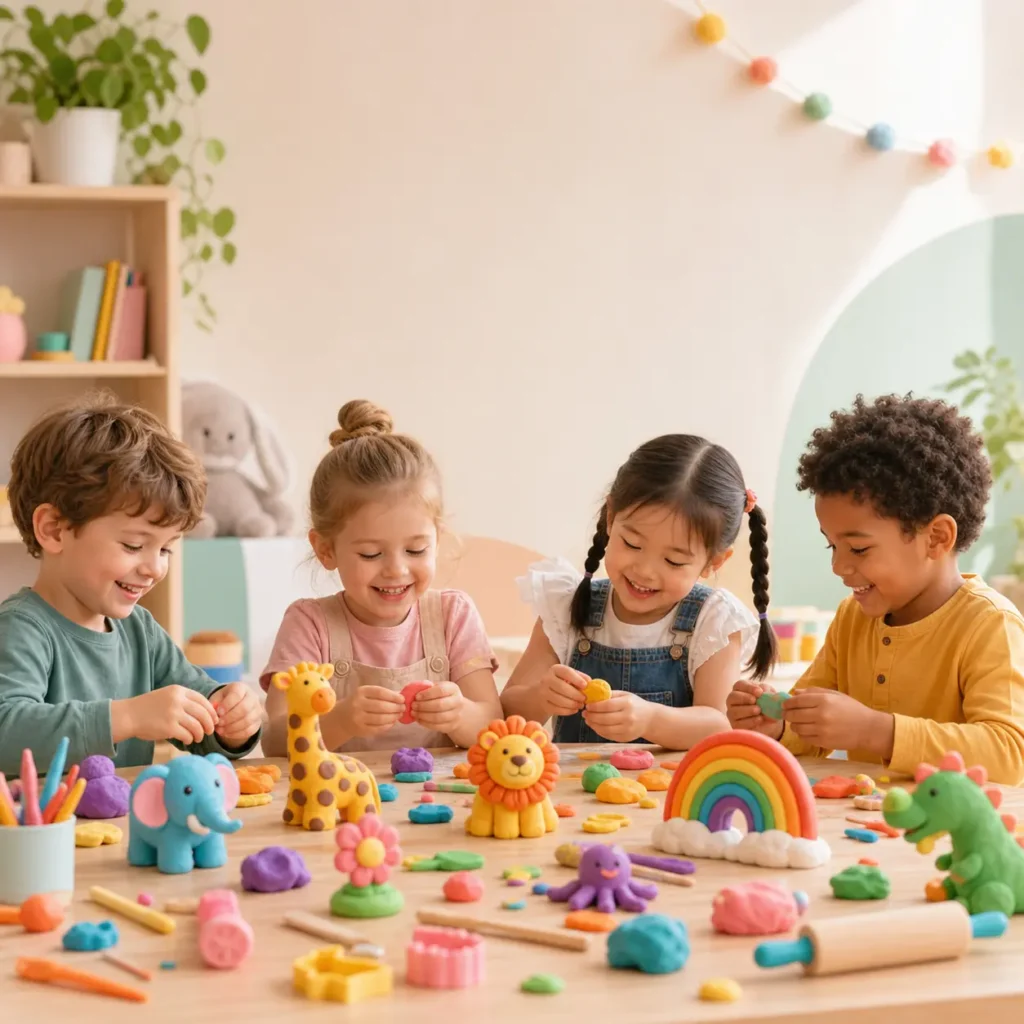
In brief :
- 20 simple ideas of modeling clay to stimulate children’s motor skills, imagination, and language.
- Creations suitable from 2-3 years for a safe and guided children’s workshop.
- Activities both playful and educational: learning colors, the alphabet, and shapes.
- Practical advice to turn each modeling session into a calming and bonding moment.
- Additional resources and inspirations to extend play at home.
Stimulate fine motor skills with modeling clay: simple creations and step-by-step instructions
Modeling clay is an ideal opportunity to work on the fine motor skills of toddlers. By handling, rolling, pinching, and flattening the clay, children train the finger muscles needed for future writing and cutting gestures.
A common thread helps make each activity more meaningful: at the Duval family, Lina, 3 years old, started with snails and rolls. These are repetitive, reassuring gestures that encourage eye-hand coordination.
Concrete examples and progression
Start with very simple shapes: ball, roll, flat cake. These shapes are easy to handle and offer quick successes.
Then propose two-step tasks: make a roll then roll it into a spiral to get a snail. This type of sequential step develops motor planning.
Guided activities to strengthen grip
An effective game is to create small pieces (fruits, little people, cars) to assemble. Children must pinch, crush, smooth, and stick the pieces together. These varied gestures recruit finger strength and precision.
For example, for a car: make a flattened body, shape four wheels, and press lightly to fix them. This multi-gesture work tolerates errors and values perseverance.
Safety and suitable materials
Before offering modeling clay, check the recommended age and make sure the child no longer systematically puts everything in their mouth. For the youngest, prefer non-toxic and soft clays.
The workshop should be short (10–20 minutes) and repeated regularly rather than long and exceptional. Small regular sessions capitalize on motor learning.
Pedagogical tip
Vary textures by sometimes offering slightly grainy homemade clay, sometimes smooth clay like Play-Doh. This enriches the sensory repertoire and promotes finger adaptation to different resistances.
For tired parents, a simple idea is to prepare models to reproduce in advance: a sheet with photo and shapes to imitate. Children like to copy and see their progress.
Insight : repeated gestures around small simple creations like snails or balls gently build the motor skills essential for school.
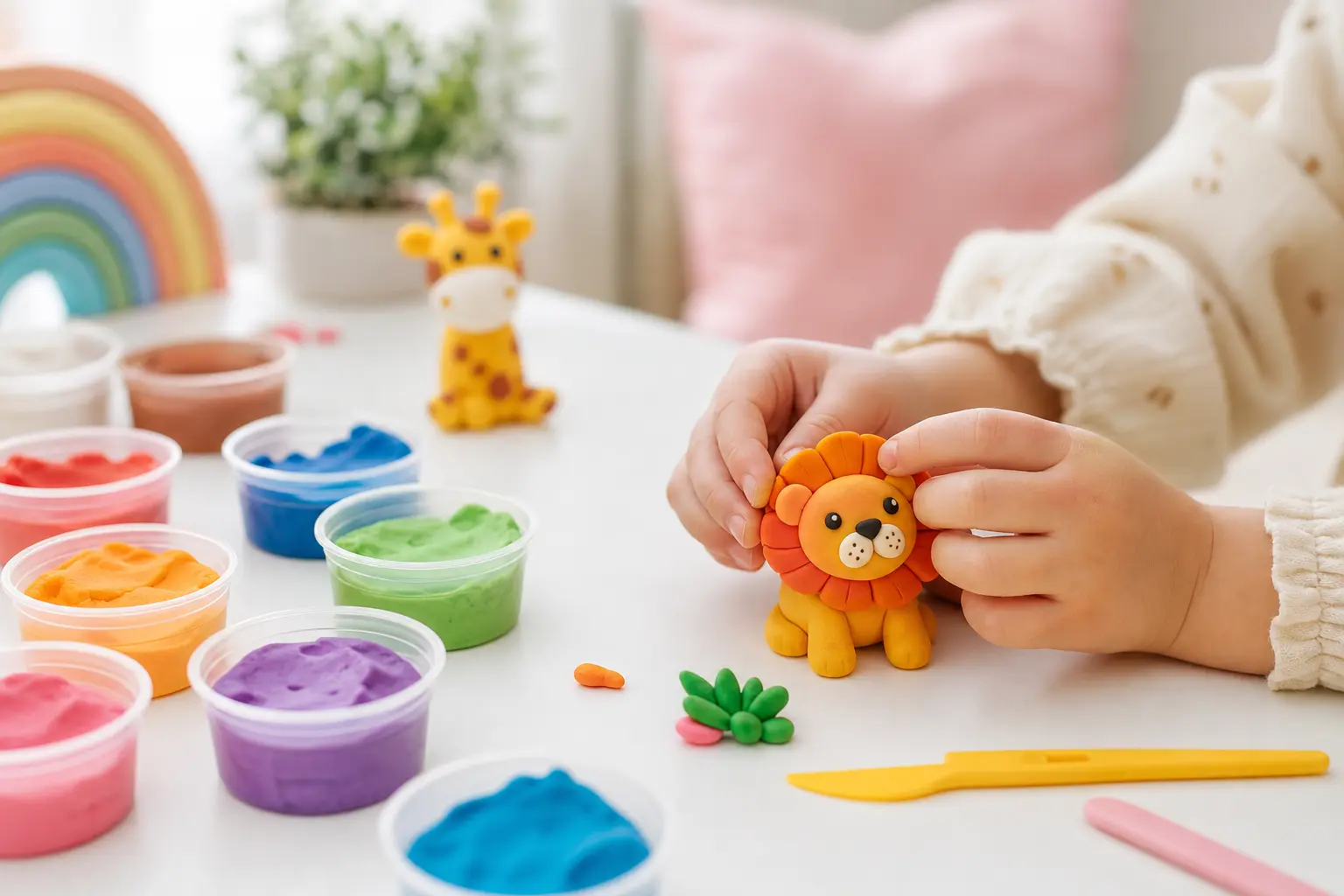
Encourage creativity and language through modeling: 20 simple creations turned into stories
Modeling clay naturally lends itself to symbolic play. Each creation can become a character, a setting, a scene. Turning a simple little person into a story stimulates vocabulary and the ability to structure a narrative.
In the Duval family, after modeling a little person, Lina invents its name, job, and favorite comfort object. Modeling becomes a scenario: a rocket takes off, a cake is shared, a house opens to welcome friends.
How modeling stimulates language
Giving short and varied instructions forces the child to understand and reproduce new words. Asking “make a red door” engages the child on colors, objects, and understanding a simple order.
Encourage description: “tell who lives in this house” makes the child use adjectives, action verbs, and temporal notions.
Create a story gallery
Setting up an exhibition corner highlights the works. A small staging around a weekly theme (animals, food, space) encourages repetition of the same words and lexical enrichment.
For example, the theme “restaurant”: model a pizza, cutlery, a waiter. Each element becomes an opportunity to learn words related to food and politeness.
DIY children’s workshops to stimulate imagination
Very simple activities, like a doll to dress or a miniature vegetable garden, encourage creativity without frustration. Older children can imagine accessories: hats, glasses, little flowers.
A parent can spice up the game by proposing a playful constraint: make a character using only two colors. This rule stimulates innovation and adaptability.
Resources and extensions
For realistic food projects, it can be inspiring to consult visual and trompe-l’œil recipe ideas to have even more fun with miniatures: trompe-l’œil recipes.
Giving a name to creations is also educational. Why not read a short sheet on the origin of a first name if the child often names their characters? An unexpected but playful example: discovering the meaning of a famous first name on the meaning of a first name can feed curiosity.
Insight : turning modeling into miniature theater enriches vocabulary and narrative construction while strengthening the parent-child bond.
After this inspirational video, a brief practice time helps anchor new gestures.
Educational game: learning colors, the alphabet, and numbers with modeling clay
Modeling clay is perfectly suited to fundamental learning. Letters, numbers, and colors can be shaped in a few minutes and handled to consolidate memorization.
With Lina, every morning starts with a letter formed from clay. This ritual combines movement, sight, and sound, a powerful combination for early learning.
Alphabet and numbers workshop
Forming letters with clay strands strengthens shape recognition and motor skills. Raised letters are easy to manipulate and allow composition games: writing one’s name, assembling simple words.
For numbers, modeling balls corresponding to the quantity (3 apples, 4 stars) helps anchor the notion of number concretely.
Examples of playful activities
1) Command game: a parent asks “bring the yellow letter M” and the child must form and show it. This game stimulates listening and color-shape association.
2) Word set to build: propose a theme (animals) and ask to compose three words in clay then read them together.
Summary table of 20 simple creations
| Creation | Suggested age | Skill worked |
|---|---|---|
| Snail | 2–3 years | Fine motor skills, spiral |
| Rainbow | 3+ years | Colors, stacking |
| Snowman | 3+ years | Shapes, decoration |
| Car | 3+ years | Assembly, imagination |
| Hamburger | 3+ years | Imitation, sequencing |
| Funny fruits | 3+ years | Fruit names, creativity |
| House | 3+ years | Spatial references |
| Rocket | 4+ years | Assembly, space theme |
| Cake | 3+ years | Decoration, proportions |
| Vegetable garden | 3+ years | Vocabulary, shapes |
| Computer | 4+ years | Location, keys |
| Lollipop | 3+ years | Spiral, decoration |
| Monsters | 3+ years | Emotional expression |
| Planet Earth | 4+ years | Geographical references |
| Pizza | 3+ years | Colors, cutting |
| Flower | 3+ years | Assembly, symmetry |
| Spaghetti | 3+ years | Filaments, patience |
| Doll to dress | 4+ years | Clothes, motor skills |
| Breakfast (eggs, sausages) | 3+ years | Shapes, imitation |
| Alphabet | 3+ years | Letters, language |
Setup advice
Prepare a dedicated space, simple tools (rolling pin, cookie cutters), and visual sheets to make the workshop more effective. Letting the child choose two creations to make during the week keeps interest high.
Insight : turning letters and numbers into manipulable objects strengthens learning by action and meaning.
Sensory and calming activities: modeling clay as an emotional regulation tool
Modeling clay can be an excellent ally to calm a child in a stressful situation. The repetition of presses, rolling between fingers, and the warmth of hands produce a physiological calming effect.
During a moment of frustration, the Duval family suggested Lina crush a ball until she calmed down. This simple gesture allowed channeling energy rather than escalating anger.
Guided sensory exercises
Offer slow and descriptive instructions: “roll a roll gently,” “press the clay then release.” These verbal instructions combined with the gesture help synchronize breathing and movement.
Add soft olfactory elements (child-friendly essential oils if allowed) or use lightly scented clay to strengthen sensory anchoring and the pleasure of the moment.
Games to name emotions
Creating monsters or faces opens up speech about emotions. A sad monster will have a mouth turned down; a smile will be an arc of clay. Asking “what is your monster’s name?” facilitates expression of feelings.
The activity encourages verbalization without pressure: the child first manipulates, then names. This alternation is often more acceptable for distressed children.
Calming routine and suitable duration
Integrate modeling clay after a nap or before bedtime to channel remaining energy. Sessions should remain short and predictable to avoid overstimulation.
Using a visual timer, or a soft song, helps the child understand the activity’s time frame.
Insight : modeling clay, through its sensory qualities and simplicity, becomes a concrete method to help the child regulate emotions without judgment.
Festive creations and DIY kids’ ideas: for birthdays, seasons, and themes
Modeling clay can be at the center of small family parties and themed workshops. Children love to see their creations showcased during a birthday cake or seasonal decor.
At the Duval family, an afternoon “rocket and planets” turned the living room table into a space workshop. The children modeled a rocket, planets, and Vinicius, the clay cat, even had a helmet.
Simple thematic ideas
Birthday party: mini clay cakes, fake candles, and little characters to take home as souvenirs.
Christmas: snowmen, stars, and mini garlands. Easter: decorated little eggs.
DIY kids: incorporating other materials
Combine modeling clay with recycled elements (caps, small boxes, wooden sticks for lollipops) to increase creativity. Pay attention to safety: check for sharp items for the youngest.
Offer a workshop where each child creates a decoration to hang or a small freely reusable toy, valuing effort and extending play.
Sharing and valuing
Organize a mini family exhibition, photograph the works and share them with grandparents or in a creative notebook to enhance the child’s pride.
For inspiring and trompe-l’œil gourmet ideas, the site showing visual recipes can stimulate the imagination for edible and non-edible decorations.
Insight : festive workshops turn modeling clay into a social bonding tool and a tangible memory for the whole family.
}}}}]}At what age should modeling clay be offered?
Modeling clay is suitable from about 2 years old if the child no longer systematically puts everything in their mouth. For younger children, prefer supervised manipulation games and non-toxic clays.
How to prevent the clay from drying out?
Keep the clay in an airtight container, away from heat. For partial drying, knead the clay with a little water (if the recipe allows) or prepare small amounts for each session.
What skills does modeling develop?
Modeling stimulates fine motor skills, language, creativity, planning ability, and emotional regulation. It is a truly comprehensive educational game.
Can you make modeling clay yourself?
Yes, there are simple and safe homemade recipes. Use ingredients adapted according to the child’s age and check the consistency before each activity.