In brief:
- G-spot: historic and controversial concept originating from Grafenberg’s work and later popularized; its anatomical existence is debated.
- Female pleasure depends on a whole: the clitoro-urethro-vaginal complex rather than an isolated spot.
- Stimulation: practical methods and positions described to explore internal and external erogenous zones.
- Concrete advice for approaching sexuality after childbirth, linked to perineal rehabilitation and bodily comfort.
- Additional resources and references to continue sexual education and postnatal support.
G-spot: anatomy, myth and reality according to sexology
The term G-spot refers to a supposedly particularly erogenous zone, historically described by Ernst Grafenberg and brought back into focus by Beverly Whipple in the 1980s. This notion has fueled both curiosity and skepticism. Scientifically, the existence of a unique and universal spot is not consensually demonstrated. Anatomical and clinical research rather shows significant interindividual variability.
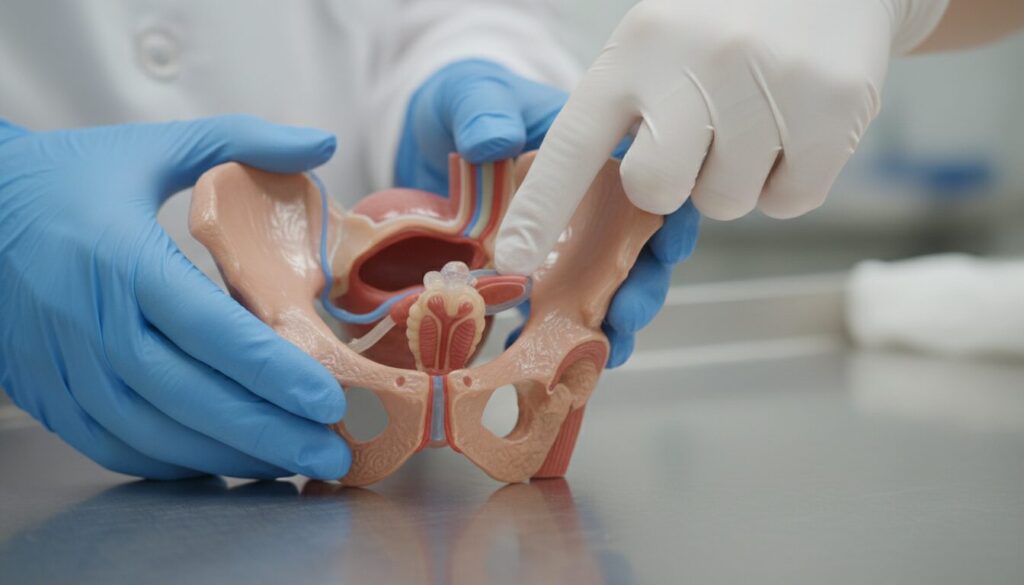
In modern sexological discourse, the trend is to consider not an isolated spot but a clitoro-urethro-vaginal complex. This concept highlights the continuity between the visible part of the clitoris and its internal extensions surrounding the vaginal wall. These structures share a high density of nerve endings and can be stimulated through various forms of stimulation.
Why does the debate persist?
Several reasons explain the ongoing debate about the G-spot. First, anatomical variability: in some people, a more sensitive bulge is easily felt, in others there is nothing notable. Then, study methods have evolved: imaging, clinical exams, and subjective surveys sometimes produce divergent results. Finally, intimate subjective experience plays a major role: the perception of pleasure is linked to arousal, trust, and relational context.
Advocates of a specific zone describe it as a small erectile tissue, about 1 cm, located on the anterior vaginal wall, between 3 and 5 cm from the entrance. Other specialists remind that stimulation of this area cannot be separated from clitoral stimulation, as the clitoral membrane and roots cover and run along the vaginal walls.
Illustration: the case of Sofia and Marc
Sofia and Marc, a fictional couple chosen as a narrative thread, seek to better know each other after the birth of their first child. Their experience illustrates the central point: the discovery of pleasure is not linear. Sofia previously felt mainly clitoral sensations. After some guided explorations, she notes that certain pressures on the anterior vaginal wall, combined with external stimulation, significantly increase arousal. This discovery approaches the idea of stimulation of a sensitive bulge without validating the existence of a universal anatomical point.
In practice, the discourse recommended by sexologists favors a holistic approach: explore, communicate, adapt gestures and recognize that the experience of female pleasure is multifaceted. Key insight: talking about the G-spot can be useful to name sensations, but prioritizing the clitoro-urethro-vaginal complex provides a more complete and concrete action framework.
Location and stimulation techniques to explore female pleasure
Searching for the G-spot, when undertaken, follows practical steps to maximize comfort and discovery. Preliminary arousal is essential: without natural lubrication and relaxation, palpation risks being uncomfortable. Foreplay, listening, and external stimulation prepare the body.
Concrete steps for a safe exploration
1) Begin with foreplay and encourage natural lubrication.
2) Choose a comfortable position for the person being explored: lying down, on all fours, squatting, or in a position where they control the angle.
3) Insert one finger two phalanges inside the vagina, orient the pad toward the navel, and make a “come here” motion while palpating the anterior wall.
4) Look for a more sensitive bulge, a less smooth area, sometimes more spongy.
5) Combine internal and external stimulation: stimulating the clitoris at the same time often amplifies the response.
These steps should be done in a calming atmosphere, without performance pressure. Individual masturbation can be a safe and autonomous way to learn preferences and thus facilitate discovery as a couple.
Positions favoring contact
Several sexual positions favor the angle conducive to contact between the internal part of the clitoris and the anterior vaginal wall. Among those classically described:
- Andromache / straddling: the person on top controls the angle and can adjust pelvic tilt.
- Spooning position: allows fine control of depth and favors gentle stimulation.
- Right angle: edge of the bed, pelvis protruding, nearly perpendicular angle, favors more targeted contact.
- Swing: position facing away from partner’s back, with control to lean the torso forward.
These positions do not guarantee anything universally but offer anatomical configurations likely to increase the probability of stimulating contact. Key insight: structured and consensual experimentation, rather than seeking a “standard” response, is the most effective way to discover pleasure.
After this video, it is useful to open a time for exchange with your partner to determine what was perceived and what should be repeated or adjusted.
Postnatal implications: perineal rehabilitation, intimacy, and resuming sexuality
The postnatal period often changes the body and perception of sexuality. Childbirths, depending on how they proceed, can impact the pelvic floor, vaginal sensitivity, and body image. Perineal rehabilitation plays a central role here in regaining tone, comfort, and confidence.
It is recommended to address this topic proactively with healthcare professionals. Targeted exercises, follow-up, and sometimes sexological support help reduce pain and facilitate resuming sexuality. For parents seeking practical resources after birth, guides on rehabilitation can be consulted, such as those offered on Laviedebebe.
Practical advice for new parents
1) Resume sexuality at your own pace: no pressure to return to “life before”.
2) Communicate about fears, expectations, and changed sensations.
3) Try non-penetrative stimulations first: clitoral caresses, massages, affectionate exchanges.
4) Consult in case of persistent pain: early care prevents the establishment of avoidance behaviors.
Parenting also involves practical and logistical concerns that can weigh on intimate life. To support daily life and regain moments of closeness, advice on newborn comfort and family organization is useful; some reference pages on Laviedebebe provide concrete benchmarks to lighten mental load and create moments for two.
Finally, perineal rehabilitation contributes not only to physical comfort but also to pleasure: a toned pelvic floor sometimes facilitates the perception of internal and external stimulations. Key insight: investing in postnatal follow-up is a concrete way to protect sexual health and couple well-being after birth.
Practices, precautions, and resources for calm sexual education
Exploring female pleasure must fit into a respectful, informed, and praxis-oriented sexual education approach. Myths about the G-spot can create unrealistic expectations: it is better to substitute myths with clear techniques and benchmarks.
List: golden rules for serene exploration
- Prioritize mutual consent and comfort.
- Start with external stimulation before any internal exploration.
- Use lubricant if necessary to avoid discomfort.
- Communicate during the act: what pleases, what bothers, the intensity.
- Consider professional support in case of pain or blockage.
A summary table helps visualize suitable positions, gestures, and contexts:
| Objective | Position/Gesture | Advantage |
|---|---|---|
| Explore anterior wall | Straddling (person on top) | Control of angle and rhythm |
| Combine clitoral stimulation | Internal finger + external stimulation | Amplification of arousal |
| Gentle postnatal resumption | Non-penetrative caresses and massages | Reassurance and pain management |
To deepen sexual education, reliable resources, guided practice, and sexological support are recommended. Popular information has its place, but access to validated content helps avoid the pitfalls of guilt-inducing discourse. The approach must remain pragmatic and kind: test a maneuver, observe the reaction, adapt. Key insight: enlightened curiosity and communication are the strongest levers to enrich sexual life.
Does the G-spot exist in all women?
No, there is no scientific consensus proving the existence of a universal anatomical G-spot. Some people feel a sensitive bulge on the anterior vaginal wall; others do not. The contemporary approach favors the concept of the clitoro-urethro-vaginal complex to explain variations in pleasure.
How to search for the G-spot safely?
Encourage lubrication and arousal, choose a comfortable position, insert a finger two phalanges in the direction of the navel, and perform a ‘come here’ motion. Combining external clitoral stimulation often increases pleasure perception. If pain occurs, stop and consult.
Does G-spot stimulation always cause vaginal orgasm?
No. For some, internal stimulation can trigger a vaginally qualified orgasm; for others, the orgasm remains mainly clitoral. Anatomy, arousal state, and emotional context strongly influence the response.
After childbirth, what to do if sexuality has changed?
Take time to resume, follow perineal rehabilitation if recommended, communicate with your partner, and consult a professional (midwife, physiotherapist, sexologist) in case of persistent pain or psychological difficulties.