
In brief:
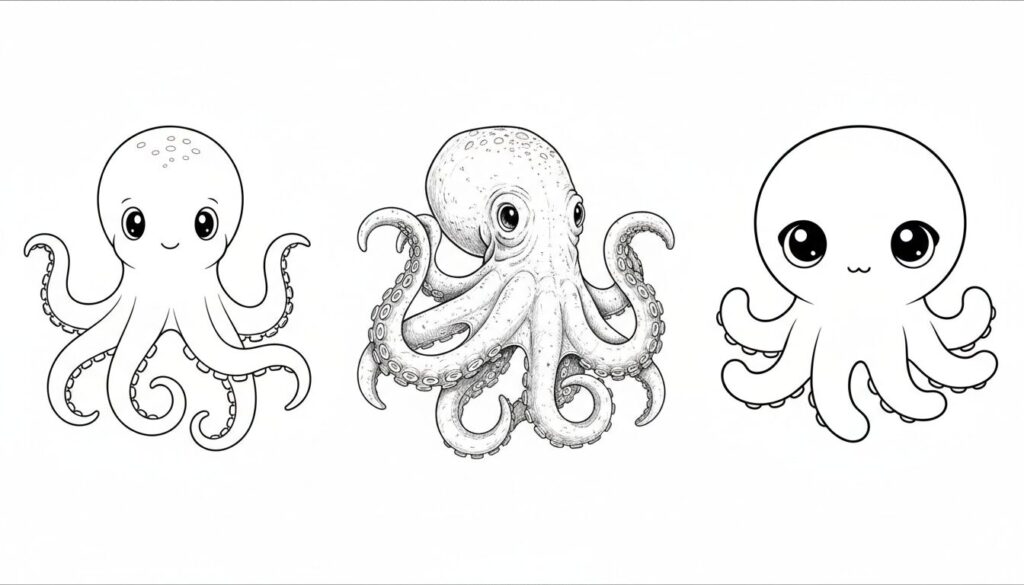
- Octopus coloring pages suitable for all ages: simple drawings for toddlers, realistic models for older children, and kawaii drawings versions to soothe and entertain.
- Educational and free activity: octopuses to print easily at home, ideal for developing fine motor skills and knowledge of marine animal drawings.
- Concrete advice for organizing a session: materials, print format, group variations, and tips to make the moment relaxed and creative.
- Practical resources: templates to download, ideas of realistic colors (chromatophores, blue blood) and suggestions for adaptations according to age.
- Simple action to try right now: print an easy drawing, offer three colors, and observe how the child chooses and tells their marine universe.
Octopus coloring pages and simple drawings to awaken toddlers’ motor skills
Simple octopus drawings are perfect for early coloring experiences. They focus on broad shapes, thick outlines, and few details — essential features for the still imprecise hands of toddlers.
Offering an octopus coloring page with wide tentacles helps work on eye-hand coordination. The repetition of the gesture of filling a surface promotes pencil control and grip. These benefits are observable from 18 months when the child holds a pencil with more confidence.
How to prepare the session for a child aged 2 to 4 years
Choose an A4 sheet and print a drawing with bold outlines. Provide thick crayons or washable markers to facilitate grip.
Set up a calm space, at the child’s height, with a rigid support. Offer a maximum of three colors at the start to avoid sensory overload.
Pedagogical steps and concrete examples
1) Show the drawing and name the octopus: “octopus” or “pulp.” Use simple and positive language.
2) Invite the child to choose a main color for the head, then one for the arms. The goal is to encourage decision-making rather than perfection.
3) Value the effort: comment on a well-filled stroke or a good pencil grip. Factual encouragement helps build confidence.
Fun adapted variations
For a child who gets bored quickly, turn the activity into a small game: place stickers on the drawn suckers or ask to color only the arms touching a printed star.
Another idea: cut out the printed octopus and stick it on a large blue sheet to create a collective marine background.
Example of a successful activity: in a daycare, a teacher offered a simple octopus drawing and three crayons. The children exchanged their ideas about colors, sharing materials and enthusiasm. This collective moment promoted both motor skills and social abilities.
These free coloring pages offer a gentle entry into the world of graphic art. Their simplicity allows turning each session into a small success, accessible to tired parents seeking a short and beneficial activity.
Key phrase: A well-chosen simple drawing transforms a coloring moment into a true motor skills workshop.
Realistic octopus drawings: observe, learn, and refine details
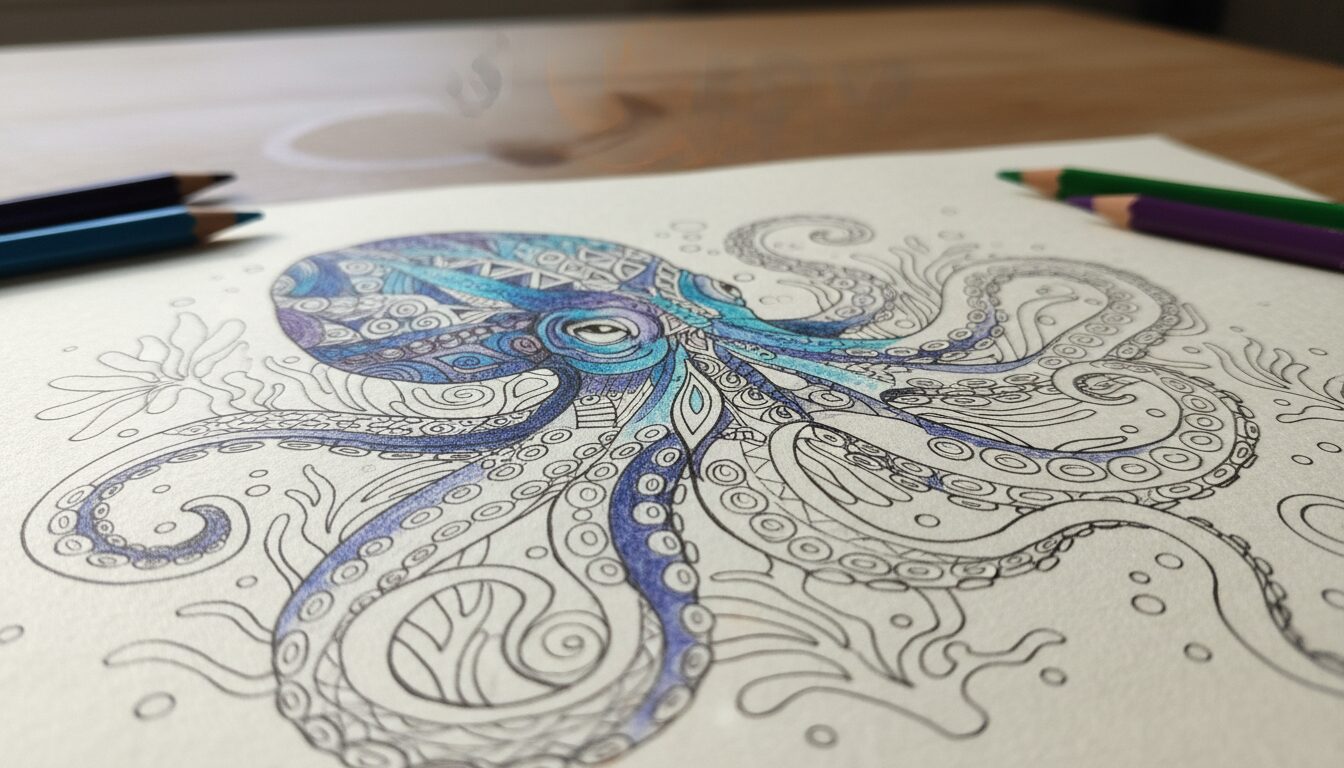
Realistic octopus drawings are a beautiful bridge between artistic activity and scientific discovery. They encourage observation: rows of suckers, arm posture, skin texture, and color variations. These drawings allow introducing simple notions about marine biology without unnecessary jargon.
Using a realistic model helps the child or adolescent develop their observation skills and ability to reproduce complex shapes. For parents, it is an opportunity to introduce fascinating facts: how the octopus changes color thanks to chromatophores, or why its blood is blue.
Techniques for coloring a realistic drawing
Start with the base: choose a dominant shade for the head. Then add darker layers under the arms to create volume. For the suckers, use a light contrast (a lighter shade in the center, darker on the edge) to give the illusion of relief.
Briefly explain the science: chromatophores allow the octopus to change its shade quickly. This can be visually translated by adding spots of slightly different colors, as one would do with watercolor.
Recommended materials and detailed steps
Prefer quality colored pencils or soft pastels to be able to layer colors. A blending pencil can help fade the shades between the arms and the head.
Steps: observe the reference photo, sketch the contours, fill large areas, add shadows and details (suckers, folds). Each step is done slowly to give the observer time to analyze.
Comparative table: levels and educational objectives
| Type of drawing | Recommended age | Skills developed |
|---|---|---|
| Simple drawing | 1.5–4 years | Fine motor skills, color choices |
| Realistic drawing | 6+ years | Observation, patience, coloring techniques |
| Kawaii drawing | 3–8 years | Emotional expression, imagination |
An activity around a realistic drawing can be held in a parent-child workshop. For example, a parent shows a picture of a real octopus, briefly explains the function of the suckers, then offers an adapted realistic coloring page. This approach fosters curiosity and provides scientific landmarks without information overload.
Integrating a short explanatory video often enriches the activity. A simple visual resource clarifies how camouflage works and makes coloring more meaningful.
Offer variations: make several drawings of the same octopus with different colors to explore the role of chromatophores. Or ask the child to imagine a bioluminescent octopus by mixing neon and pastel.
Key phrase: Realistic drawings transform coloring into active observation, linking art and science for lasting learning.
Kawaii drawings and octopuses to print: soothe and stimulate the imagination
Kawaii octopus drawings offer a soft and reassuring aesthetic: big eyes, smiles, and rounded shapes invite tenderness. For anxious toddlers or moments of calming down, these models promote relaxation.
Beyond the cute aspect, kawaii allows children to express emotions. The chosen colors often reflect mood: pastel tones for relaxation, bright colors for excitement.
Organizing a kawaii workshop at home
Print several kawaii models on different paper sizes. Offer at least one giant version for a group coloring, ideal for siblings or a small group.
Provide varied materials: crayons, lightly applied markers, sticky glitter. The goal is to encourage creativity and symbolic play: transform the octopus into a character (pirate, princess, astronaut).
Examples of activities and adaptations
1) Creative story: ask the child to invent a story around their kawaii octopus. This short narration stimulates language and imagination.
2) Sensory game: apply tissue paper on certain parts to vary textures and develop tactile perception.
3) Group workshop: each child colors a tentacle; at the end, assemble the parts to form a giant wall octopus.
Useful resources and templates to download: to find a selection of models suitable for the age, one can consult dedicated platforms that centralize octopuses to print and various models. A practical and reliable example is available via download octopus coloring pages, offering free and level-ranked options.
For variety, alternate between kawaii, realistic, and simple drawings in the same session. Children learn to compare and choose according to their mood.
Key phrase: The kawaii style is not just an aesthetic trait: it is a tool for soothing and emotional expression for the youngest.
Octopuses to print: organizing a creative, free, and inclusive activity
Printing free octopus coloring pages makes it possible to set up a cost-free and accessible activity. The choice of format and medium directly affects the experience: large format for movement, small format for precision.
Some practical tips for a smooth and enjoyable session:
- Print on slightly thick paper (120 g/m²) to avoid tears.
- Offer washable crayons to reduce stress linked to stains.
- Prepare a folder to keep finished drawings: this values the work and facilitates family sharing.
Step-by-step organization for a small group workshop
Prepare several models: a simple drawing, a realistic drawing, and a kawaii drawing. Place the realistic model as “observation” and the other two as creative versions.
Distribute the material in small stations to avoid clutter. Each station can have a theme (sea, night, rainbow) and color palette suggestions.
Adaptations for children with special needs
For a child who tires quickly, limit the session to 10–15 minutes and offer sensory breaks. For a very visual child, add real pictures of octopuses to inspire color choices.
The parental support platform can help find adapted models and simple advice for setting up the activity. A practical resource is accessible here: free octopus coloring templates, with ideas for home and daycare.
Concrete example: during a workshop at a PMI center, a team offered three drawing sizes and observed that children spontaneously chose the size corresponding to their precision level. The youngest preferred the large collective format, while the older ones thrived on the details of the realistic models.
Key phrase: Good organization transforms a simple coloring activity into an inclusive and memorable workshop.
Marine coloring and child development: creativity, concentration, and knowledge
Coloring an octopus combines creativity and learning. Beyond the graphic gesture, it mobilizes attention, visual memory, and observation skills. These abilities are useful from birth and become more complex with age.
The symbolism of the octopus — intelligence, adaptability, creativity — can be used to tell stories and encourage cognitive flexibility. For example, by inventing scenarios where the octopus changes color to hide, the child playfully understands the concept of adaptation.
Case study: Leo and his first large octopus
Leo, 4 years old, participated in a session where he had to color a giant octopus. Initially hesitant, he gradually found a rhythm and chose bright hues. His mother, Amandine, noted an improvement in his patience and his ability to stay focused for twenty minutes — a concrete progress for a child of that age.
This example illustrates how a simple, well-structured activity helps organize attention and offer small daily victories for both child and parent.
Cognitive and emotional benefits
Coloring develops planning (color choices, organizing filling) and self-esteem. It also serves as an emotional regulator: coloring can calm down after an active day.
For parents, these creative moments are opportunities to observe preferences and open exchanges: “Why did you choose that blue?” or “Tell me the story of your octopus.” These questions stimulate language and strengthen the emotional bond.
Resources and continuation
To vary and extend the activity, it is possible to introduce illustrated books about marine life, watch a short video about octopuses, or organize a “sea” themed workshop at home. These steps enrich curiosity and anchor learning.
Key phrase: Marine coloring is a simple and powerful tool to support the child’s overall development, while offering moments of shared pleasure.
How to choose between a simple, realistic, or kawaii drawing for my child?
Choose according to age and goal: simple drawings suit toddlers to work on motor skills; kawaii drawings soothe and stimulate the imagination; realistic drawings are perfect for older children who like to observe and reproduce details.
Where to find octopus coloring pages to print for free?
Dedicated sites offer varied templates to download. A practical selection categorized by level is available on the platform mentioned above, offering simple, realistic, and kawaii versions.
Which materials to favor for a stress-free session?
Favor washable crayons for young children, slightly thick paper to avoid tears, and a limited number of colors to reduce overload. Provide wipes and a protected space if necessary.