
In brief
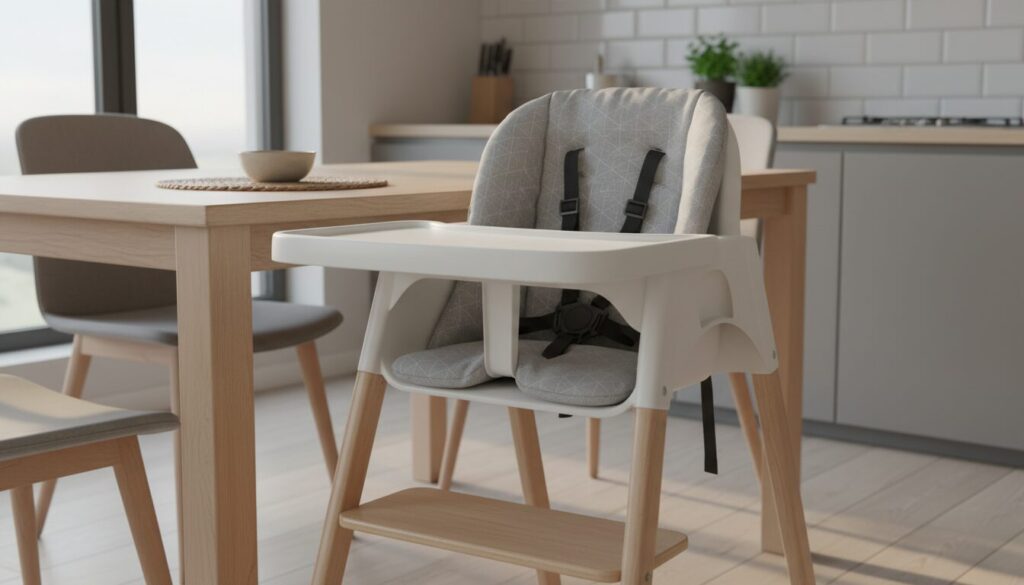
- Choosing a high chair primarily involves assessing ergonomics, stability, and adjustable features to support the child’s growth.
- Safety: prioritize a 3 to 5-point harness, a wide base, and materials certified for childcare.
- Comfort: footrest, adjustable recline, and reducer cushions promote good posture and peaceful meals for toddlers.
- Maintenance: ease of cleaning and removable covers reduce daily stress.
- Adaptability: a convertible chair can last several years and limit repeated purchases.
Choosing a high chair adapted to toddlers’ needs: practical criteria and comparison
The choice of a high chair is based on several essential criteria combining safety, comfort, and practicality. Every family’s daily life is different: some will need a compact and lightweight chair for outings, others will favor a wooden adjustable chair for use over several years. To make a useful choice, it is important to identify the main use: meals at home, frequent outings, or alternation between the two.
Ergonomics must be at the heart of the selection. A well-designed seat supports the back and hips, and an adjustable footrest helps stabilize the leg position, encouraging calmer digestion and an active posture. The presence of a reducer or reducer cushion can be decisive for infants beginning complementary feeding.
Stability is non-negotiable: a wide base and non-slip feet limit the risk of tipping during child movements. The type of harness is also crucial: a 5-point harness offers better restraint of the child than 3-point models, especially for very mobile toddlers.
Materials also come into play. Plastic chairs are often lighter and easier to clean, while wooden models bring increased durability and a timeless look. However, it is necessary to check that finishes are free of harmful substances and comply with childcare standards. The presence of a removable and washable cover simplifies daily maintenance.
Here is a summary table to compare models tested by families and professionals:
| Model | Indicative Price | Age / Weight | Key Features |
|---|---|---|---|
| Tatamia | 329€ | Recliner up to 9 kg; chair up to 15 kg | 3 in 1, 5-point harness, removable cover, adjustable footrest |
| Keyo | Base 99€ / Seat 119€ | From birth to 3 years | Modular, footrest, 3-point harness, lightweight |
| Zuma | 239€ | 6 months to ~15 kg | 5-point belt, “comfort plus” reducer |
| Tripp Trapp | 179€ | From 6 months (with baby set) | Wooden adjustable, many accessories, 7-year warranty |
| Twenty One | 289€ | Birth to 6/7 years | Organic, 10-year warranty, durable |
To choose consciously, making a small checklist helps: check the type of harness, base width, presence of a footrest, possibility to recline the backrest, and ease of cleaning. Testing the chair in-store, if possible, allows evaluation of ergonomics and the adult’s grip.
A practical tip is to compare the seat to a daily situation: imagine placing a baby aged 6 to 9 months and simulate meal gestures. Sophie, mother of twins, reminds that easy access to the tray and space for the spoon are often neglected during purchase but make all the difference daily.
Key takeaway: selecting a high chair means combining ergonomics, stability, and adjustable options to follow the child. A good chair reduces tensions during meals and promotes moments shared in complete safety.
Daily checks and safety standards: protecting baby during meals
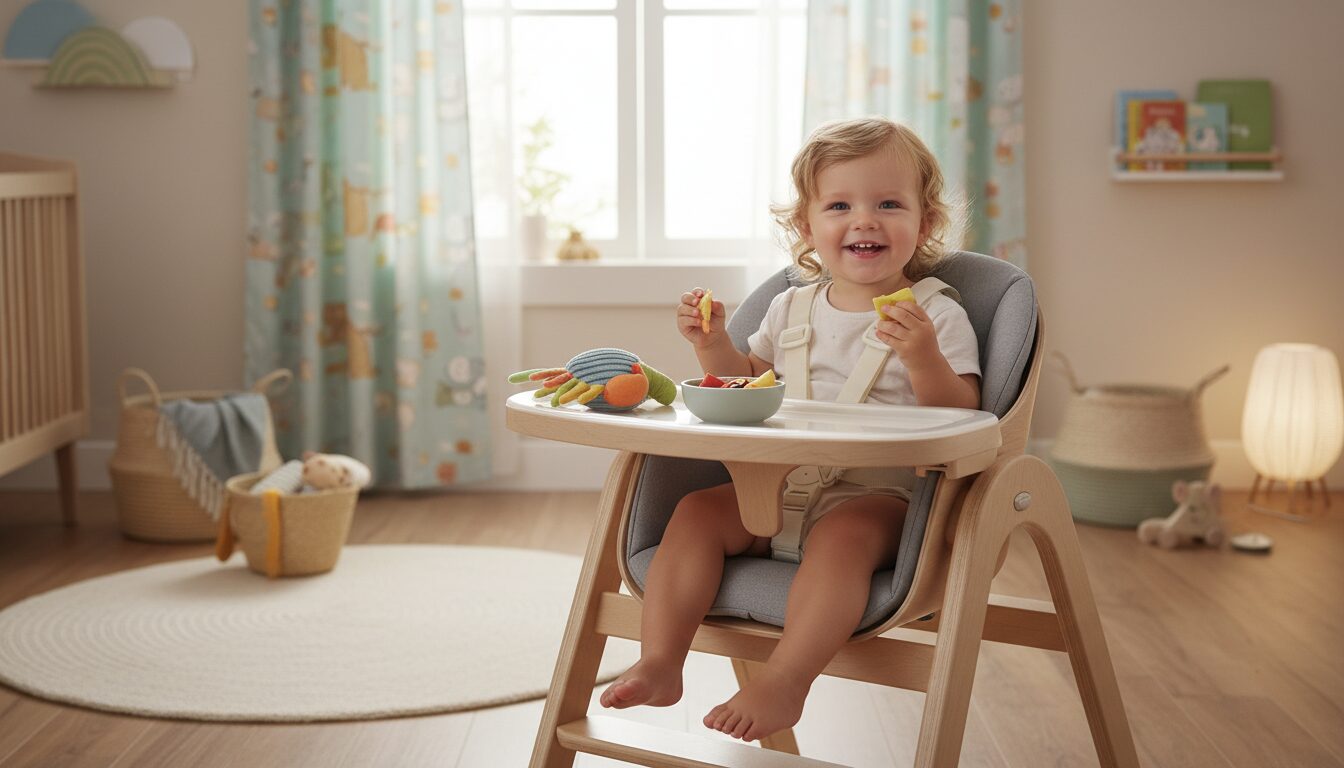
Safety is not only purchased at the selection stage: it is maintained daily through simple and systematic checks. Before each meal, a quick check of the harness, tray locks, and chair stability considerably reduces risks. An improperly buckled harness or a tray poorly engaged are frequent causes of domestic accidents.
Start by checking the restraint system. A 5-point harness is recommended for very active children; it holds the shoulders and pelvis, limiting the possibility of slipping underneath. 3-point harnesses remain acceptable for calmer children or when the chair’s structure offers firmer enclosure. Ensure the straps are neither worn nor tangled to increase safety.
Then, check stability and pivot points. Folding chairs must lock firmly in the open position. Feet must be well anchored and, if present, brakes must function correctly to prevent any movement. If the chair has wheels, remember to immobilize them before placing the child.
Standards and labels help guide: look for compliance with European or national childcare standards, as well as independent testing. Manufacturer warranties, such as 7 or 10 years offered by some models, indicate a certain robustness but do not replace regular checks.
Practical checklist before each use
Here is an actionable list to keep handy:
- Check that the harness is properly adjusted and fastened.
- Ensure the tray is firmly locked and clean.
- Test stability by applying slight pressure on the backrest.
- Check no objects are stuck in the hinges or between the legs.
- Inspect the condition of straps and seams.
If a part appears defective, replace it before any use. Some brands sell harnesses or spare parts, which avoids discarding a chair that remains generally safe. In case of doubt about the source of a mechanical weakness, contact after-sales service or consult expert resources. Articles available on La Vie de Bébé — local guide can direct you to repair workshops or partner retail points.
Finally, a often overlooked point: proximity to dangerous objects. Do not place the chair near a stove, accessible electric cord, or unstable table. A clear space around the seat reduces the risk of snagging and promotes a serene meal.
Key understanding: quick and regular checks keep the high chair a safe space for meals and socializing around the table.
Comfort and ergonomics: seating baby for peaceful meals and supportive development
Comfort directly influences meal quality: a poorly seated child grumbles, moves, and sometimes refuses to eat. A chair designed according to principles of ergonomics facilitates acceptance of mealtime and supports postural development. Elements to consider include seat depth and width, backrest inclination, and the presence of an adapted footrest.
The footrest plays a often underestimated role. By supporting the feet, it offers a push-off point to gently push and stabilize the pelvis. This position encourages maintaining an aligned spine and better trunk control, useful for chewing and swallowing. Chairs with adjustable footrests can thus accompany growth and limit harmful bent postures.
Reducer cushions are useful from birth or for toddlers needing extra support. They provide immediate comfort and facilitate transition from recliner to high chair. The presence of a discreet lateral support can also secure the child without restricting natural movements. For example, the “comfort plus” reducer in the Zuma model combines support and padding, which appealed to several parent testers.
Material quality influences both comfort and hygiene. Breathable fabrics and easy-to-wipe surfaces reduce skin irritations and simplify maintenance. Finishes must be soft to the touch and avoid irritating seams in the groin or shoulder folds. Choosing safe materials and hypoallergenic ones is a guarantee of peace of mind.
Concrete example: Sophie, who tried several models with her twins, notes that seat variation and the presence of a padded harness transformed the atmosphere of meals. When babies feel well seated, they stay longer at the table and participate more in family moments. This observation illustrates the physical and emotional effect of a well-thought-out chair.
Finally, consider the practicality of accessories: a removable and washable tray, a detachable play arch for the youngest, or the easy removal of the cover are details that improve daily life. Frequent maintenance becomes less burdensome, and meal time stays focused on interaction rather than cleaning.
Final insight: an ergonomic high chair is not a luxury; it is a tool that protects the child’s posture and facilitates cohabitation at meals.
Adjustable high chair and durability: investing for years of shared meals
Choosing an adjustable high chair can be an economic and ecological decision. Convertible models offer configurations for newborn, toddler, and sometimes classic childhood stages. They avoid multiple purchases and adapt the seat to the changing needs of the child.
Wooden adjustable chairs, like some tested models, bring robustness that often justifies a higher initial price. They are designed to adapt: low position for toddlers, standard seat for a bigger child, or even adult chair by adding elements. This type of purchase fits into a sustainable approach and values renewable materials if manufacturing is responsible.
Modularity calls for particular attention: check availability of spare parts and ease of transformation. Modules sold separately (baby set, reducer cushion, additional harness) offer appreciated flexibility. It is important to anticipate these additional costs in the overall budget.
Long warranties, like those up to 10 years, testify to sustained investment. They can cover structural defects and reassure about longevity. Moreover, some “organic” labeled models use surface treatments more respectful of health, which is a choice factor for parents sensitive to chemicals.
A familiar case study: Marie and her little Charlie opted for an adjustable chair after testing a plastic chair during the first year. Switching to a modular wooden chair allowed using the same equipment after Charlie’s 2nd birthday, reducing subsequent purchases and offering a more stable seat during preschool years.
Beyond savings, durability also concerns maintenance. Chairs with easily washable covers or surfaces that disinfect quickly maintain optimal hygiene without excessive effort. This prolongs lifespan and maintains sanitary conditions adapted to toddlers.
Finally, integrate the social and cultural dimension: sharing an adjustable chair among siblings or passing it between relatives extends its use and inscribes the object into a family story. The investment transforms into family memory, which makes sense for parents keen on reducing waste.
Key conclusion for this section: a well-chosen adjustable chair combines comfort, safety, and durability, offering a pragmatic and respectful solution for children’s meals over several years.
Practical tips for installation, cleaning, and daily life around the high chair
Daily, small routines transform the meal experience. Placing the chair near the family table encourages inclusion and social learning. Seating the child at eye level encourages imitation and participation. These simple gestures contribute to calmer meals for the whole family.
For maintenance, a quick routine after each meal prevents dirt buildup. Removing the tray and rinsing immediately eliminates residues that stick and become harder to clean. Using a soft sponge and a product suitable for food surfaces preserves materials and prevents damage to paint or plastics.
Here is a list of very practical maintenance actions:
- Wipe the tray after each meal with a wipe or damp cloth.
- Remove and wash the cover once a week in the machine if possible.
- Check corners and hinges to avoid accumulation of stuck food.
- Disinfect frequently touched surfaces weekly.
- Regularly check fastenings and tighten if necessary.
For outings, lightweight or folding chairs are practical. It is advisable to have a small kit including a towel, a wipe, and a bag to carry waste. Mobility often involves choosing a compact and easy-to-fold model, while maintaining criteria of stability and safety.
For stubborn stains on a cover, test first on a hidden part to check colorfastness. Natural products (diluted vinegar, Marseille soap) often help and limit exposure to chemical agents. For wooden materials, avoid water saturation and prefer a damp cloth followed by quick drying.
Finally, some tips to make mealtime a calming moment: prepare a colorful plate suitable for the child’s age, gradually introduce utensils, and keep a meal-start routine (short song, small greeting). Meals thus become a social and sensory learning for the toddler.
Simple action to test: next time, place the chair so the child sees the faces of guests and check the footrest adjustment to observe the impact on attention span during the meal.
When can you place baby in a high chair?
Most high chairs are designed for use from 6 months, when the child holds their head. Some modular models accept the recliner position from birth; it is then necessary to check the weight capacity in kg and the available reducer.
Which type of harness should be preferred?
A 5-point harness offers the best safety for the most active toddlers. A 3-point harness may suit calmer children, provided that the chair has good enclosure and a stable base.
How to maintain a high chair daily?
Wipe the tray after each meal, wash the cover regularly, and check the hinges once a week. For stubborn stains, use mild products and check material compatibility.
Is an adjustable high chair worth the extra cost?
Yes, if used over several years or for several children. It often reduces successive purchases and offers a durable piece, especially if spare parts are available.