In brief:
- La Marseillaise was born in Strasbourg in 1792 and authored by Rouget de Lisle; it became the national anthem of France.
- The lyrics, often reduced to the first verse and chorus during ceremonies, carry images of combat but aim to defend liberty and fraternity.
- Understanding the historical meaning of phrases such as « Qu’un sang impur » helps to defuse fears and explain the revolutionary heritage to younger generations.
- Current use: first stanza sung at official and sporting events; the rest of the verses remain largely unknown but documented.
- For parents, turning the listening experience into a pedagogical and calming moment is possible: adapted musical versions, simple narratives, and playful activities.
La Marseillaise: historical origin and birth during the French Revolution
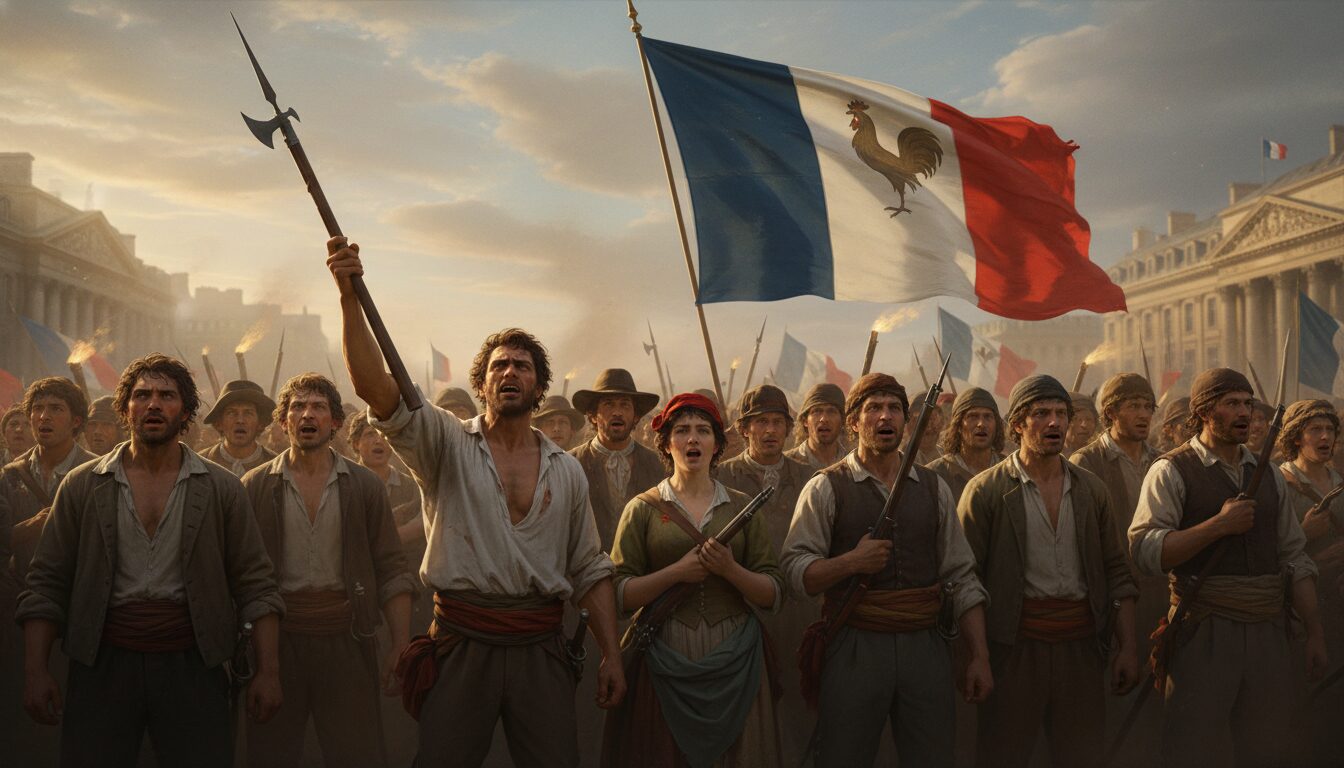
The genesis of La Marseillaise took place in a context of conflict and urgency. Written in the night of April 25-26, 1792 by Claude Joseph Rouget de Lisle, then a captain of the engineering corps in Strasbourg, the song responded to France’s entry into war against Austria. The creation fits within the bubbling atmosphere of the French Revolution, where music served as a catalyst for collective emotions and a call for unity.
Initially, the title was not fixed: the song was first known as “War Song for the Army of the Rhine” or “Marching Song of the Volunteers.” Its popular adoption in Marseille is told through the march of the Marseille federal guards who, while crossing France to go to Paris, sang this piece.
The role of Marseille and the popular denomination
Doctor François Mireur, who returned to Marseille to mobilize volunteers from the South, published and circulated the song under the title “War Song of the Armies at the Borders.” During their triumphant entry to the Tuileries on July 30, 1792, the Marseille federal guards gave new momentum to the piece. The Parisian crowd, charmed, soon called it “La Marseillaise.”
This geographical attribution symbolizes the idea of national unity, spanning France “from Strasbourg to Marseille.” The label endured, transforming a front-line song into a popular anthem.
Political context and figures of the period
The song is embedded in the heart of a moment when the nascent Republic defended itself against foreign powers and royalist factions. In public debates, figures such as Guillotin are mentioned as symbols of an era where political violence was part of the landscape. It is useful to recall that music carries as much emotion as demand. The radical lyrics reflect the anger and will for emancipation of the time.
La Marseillaise was adopted by the Convention on July 14, 1795, as the national song, then set aside in certain periods (Empire) before being definitively recognized under the Third Republic from February 14, 1879.
Concrete example: how history can be told to a young parent
For a young mother like Emma, who accompanies her infant to early civil ceremonies, it is reassuring to hear the history presented simply: an officer composed a song to encourage soldiers against threatening forces; the crowd took it up and it became a symbol of liberty. This brief story transforms sometimes intimidating lyrics into a narrative of collective defense.
In summary, La Marseillaise was born from a specific military and revolutionary context. Its name, dissemination, and official adoption reflect a period when music contributed to forging a nation’s identity. This historical overview helps to place the lyrics in their era and to approach their interpretation with nuance and pedagogy.
Complete lyrics and meaning of the verses: line-by-line analysis and explanations
Most French people know only the first verse and the chorus of La Marseillaise. Yet the anthem contains seven full stanzas, each bearing images and vocabulary rooted in the revolutionary struggle. Decoding these lines helps to understand the original intent and to relativize certain shocking formulations out of their context.
Analysis of the first verse and chorus
“Let’s go, children of the Fatherland, / The day of glory has arrived!” is a collective call. The term Fatherland refers to the nation, to the idea that collective defense prevails.
The phrase “Let an impure blood / Water our furrows” is often misunderstood out of context. Here, “impure blood” refers to forces perceived as having betrayed the nation — social classes accused of wanting to put the people back into servitude. The expression does not identify a foreign people but conveys indignation against those deemed collaborators of counter-revolution.
Less-known verses: nuances and themes
The following verses develop themes of vigilance against “foreign cohorts,” national pride, and a call for citizen solidarity. They alternate denunciation of despots, heroic imagery of defenders, and invitation to clemency towards victims forced to fight.
For example, the verse containing “Frenchmen, as magnanimous warriors, / Carry or hold back your blows!” calls to temper violence when possible. Thus, the anthem contains both martial accents and calls for humanity.
Synthetic table of the verses
| Verse | Main theme | Representative excerpt |
|---|---|---|
| 1 | Call to national defense | “Let’s go, children of the Fatherland…” |
| 2 | Denunciation of traitors and return to slavery | “It is us they dare meditate / To return to ancient slavery” |
| 3 | Threat of foreign armies | “What! Foreign cohorts / Would make law in our homes” |
| 4 | Resolution and renewal of forces | “Everyone is a soldier to fight you…” |
| 5 | Call for humanity towards victims | “Carry or hold back your blows! Spare these sad victims” |
| 6 | Liberty as a driving force | “Sacred love of the Fatherland… Liberty, beloved Liberty” |
| 7 | Commitment of younger generations | “We will enter the career… We will have the sublime pride” |
Concrete examples to explain the lyrics to children
For a parent like Emma who wants to approach these lyrics with a young child, it is useful to transform the warrior images into simple notions: some phrases talk about protecting one’s home and loved ones, others about not letting groups decide for everyone. Using analogies from daily life — sharing, defending a friend, refusing injustice — helps translate historic phrases into contemporary values.
Ultimately, decoding the verses of La Marseillaise sheds light on the balance between the claim for liberty, call for fraternity, and martial images typical of a wartime era. This contextualized reading helps teach without dramatizing and preserves memory while reassuring.
Final insight: placing each phrase in its historical context turns a potentially violent reading into a message of defense of liberty and national unity.
Modern use: the national anthem in ceremonies, sports, and collective memory
In contemporary practice, La Marseillaise is heard during official ceremonies, commemorations, and sporting events. The first verse and chorus form the core of the public performance. This selection seeks to focus the emotion and symbolism without mobilizing the entire text, sometimes perceived as too long or too marked by its era.
Official and sporting practices
At international meetings — matches, Olympic Games — and state ceremonies, the sung version is often shortened. The French army regularly participates in official renderings through military bands and choirs, emphasizing the link between musical heritage and republican pride.
Stadiums mobilize the fervor of the public around the anthem. For parents present with an infant, these moments can be loud; it is useful to anticipate with appropriate hearing protection or to explain the solemnity’s meaning to the child, even if very young.
Memorial work and contemporary debates
The song also remains at the heart of debates: some criticize certain wordings, others insist on the necessity to protect republican memory. In 2026, these exchanges continue to enrich civic understanding. The important thing is to maintain the ability to teach liberty and fraternity beyond controversies.
Example: during a local tribute, the municipality adapted the rendering to include prior historical explanations and an instrumental version, making listening accessible to families and avoiding offending sensitivities.
Resources for parents and professionals
Parents who seek to support their children can find educational resources on platforms such as laviedebebe.com, which offers activity sheets to turn listening into a moment of calm learning. Workshops in daycare centers, for example, combine a simple reading of the lyrics with symbolic games (paper flags, rhymes on solidarity).
Finally, the national anthem, far from being a relic, remains an identity marker and educational tool. The choice of adapted musical versions or contextualized explanations makes listening an opportunity for family exchange rather than a moment of tension.
Key phrase: used wisely, La Marseillaise can become a vector for learning citizenship without intimidation.
Music, interpretations, and emotions: how melody supports the message
The power of La Marseillaise lies as much in its words as in its melody. The melodic line, clear and ascending, encourages collective adherence and conveys a martial energy that lasts deeply in auditory memory.
Musical characteristics and interpretations
The rhythmic structure, close to a march, facilitates choral singing. Military orchestrations reinforce solemnity; modern arrangements often seek to soften the message for wider audiences, including children. Piano or lullaby versions exist, ideal for introducing the theme to toddlers without the intimidating aspect of a large ensemble.
Contemporary performers offer varied polyphonic and instrumental arrangements, demonstrating the piece’s plasticity. This diversity offers entry points suitable for various situations: celebrations, educational moments, or family listening.
Example of parental use
For a family with a newborn, turning listening to the anthem into a gentle ritual can be useful. For example, choosing an instrumental version during a trip or a bedtime ritual exposes the child to cultural elements without emotional overload. Sophie, a young mother, tried a piano version during the nap; the listening became a reassuring pause rather than a stressful moment.
Local interpretations — choirs, municipal bands — also provide a community dimension. Attending a rehearsal or a performance reduces the distance between the child and national culture, turning the anthem into a shared social experience.
Practical advice for integrating music
Simple gestures: prefer an instrumental version for very young children, accompany listening with brief anecdotes about the historical origin, use a fabric flag for sensory play. These family rhythm-respecting practices facilitate the integration of notions of patriotism and solidarity without imposing excessive emotional burden.
Insight: music opens a gentle door to history and values, provided the tempo and volume are adapted to the child’s age and needs.
Teaching values: explaining liberty, fraternity, and patriotism to young children
Turning the listening of La Marseillaise into a moment of learning requires a kind and age-appropriate approach. For parents, this means explaining abstract concepts — liberty, fraternity, patriotism — with concrete examples and playful activities.
Simple and non-guilt-inducing pedagogical methods
Offer short stories where characters share, help each other, or defend a friend to make these values tangible. For example, telling how a neighbor helps return a toy to a child illustrates fraternity. For liberty, talking about the choice to play or not at a game shows the difference between constraint and autonomy.
Pedagogy must remain non-judgmental: avoid moralizing, favor observations, and encourage concrete actions. A parent might say: “Today, we helped Camille pick up her books, we showed solidarity” rather than “You must be patriotic.”
Practical activities and examples
- Flag game: make a small flag together to approach symbols.
- Simplified reading: tell the creation of the song as the story of a melody born to protect the community.
- Soft song: use an instrumental version to soothe and explain that music unites people.
- Helping workshop: organize a small solidarity gesture at home (sharing a snack) to illustrate fraternity.
These quick and accessible activities give parents immediate tools to transform a potentially formal moment into an educational and reassuring experience.
Main thread: Emma’s journey
Emma, the parent featured throughout this article, followed these steps: progressive listening, simple explanation of the historical context, then a creative activity (making a flag), and finally gentle musical listening. Her experience shows that it is possible to integrate the national anthem into family life without pressure.
In 2026, digital and local resources (associations, daycares) offer additional support. laviedebebe.com provides practical sheets to adapt these ideas daily and guide exhausted parents toward concrete and calming gestures.
List of simple actions to try today:
- Choose an instrumental version and listen at a low volume.
- Briefly tell the origin of the song in age-appropriate terms.
- Create a small ritual (flag, short song) that reassures the child.
- Turn the symbolism into concrete daily solidarity gestures.
Key phrase: teaching liberty and fraternity passes through simple, repeated, and kind gestures more than scholarly speeches.
Why is only the first verse of La Marseillaise often sung?
The first verse and chorus concentrate the central themes and are the most recognizable. The other verses, longer and marked by their era, are rarely sung during ceremonies for practical reasons and emotional tone.
What does ‘Let an impure blood water our furrows’ mean?
In the 1792 context, the expression targets social categories perceived as betraying the nation, not a foreign people. It is a strong image linked to the fight against counter-revolution and not generalized xenophobia.
How to approach the anthem with a very young child?
Prefer an instrumental version, simply tell the origin as a story of collective protection, and offer a tactile activity (making a flag) to make the experience concrete and reassuring.
Where to find educational resources for parents?
Specialized platforms like laviedebebe.com offer practical sheets, games, and workshop ideas to turn listening to the anthem into learning moments adapted to toddlers.